
UNIQA Climate and Sustainability Strategy
Our positioning on sustainability
1. Guiding Principle for the sustainable Value Creation Approach
Times are challenging and our circumstances are constantly changing. Therefore, we carefully address the dynamic framework conditions that we consider conducive to a better life. Value creation is most meaningful where the match between our capabilities and service offerings and the needs of society are greatest. To this end, we engage in discourse, share our perspectives and commit ourselves to ensuring that sustainable benefits arise from our actions. Accompanied by a clear stance, we build trust with all our stakeholders so that our long-term reputation with customers, shareholders, employees and the public can continue to grow as a foundation for the future.
The framework within which we act is defined by:
• the orientation towards existing and future needs of society („UNIQA World View“),
• the strategic further development of our company aligned to this in the UNIQA Strategy 3.0: "Growing Impact",
• the anchoring of non-financial strategy cornerstones and operationalisation in corporate management and in remuneration models,
• participation as a member of international associations for the improvement of global ecological and social framework conditions („ESG-oriented memberships“),
• commitment to transparent disclosure regarding relevant environmental, social and governancerelated issues, • commitment to transparency and principles of respectable business practices (Code of Conduct).
Our long-term strategy for this is holistic. With the commitment of all employees, it combines our economic endeavors with a clear ecological and social commitment to the environment and society. In doing so, we aim for a sustainable value creation approach. In our management approach, we therefore pursue financial and non-financial objectives.
The UNIQA sustainability strategy is pursued in the Group‘s key areas of investment management, underwriting and operational ecology with long-term objectives and implemented within the framework of „critical initiatives“. It combines our economic striving with a clear ecological and social commitment to the environment and society and ensures ESG integration into the core business.
The related goals, measures and plans, as well as the comparison with ongoing progress, are the subject of our ongoing disclosure and reporting to our stakeholders. The focus is on our commitments arising from numerous memberships and the European objectives in the transformation to a sustainable economy.
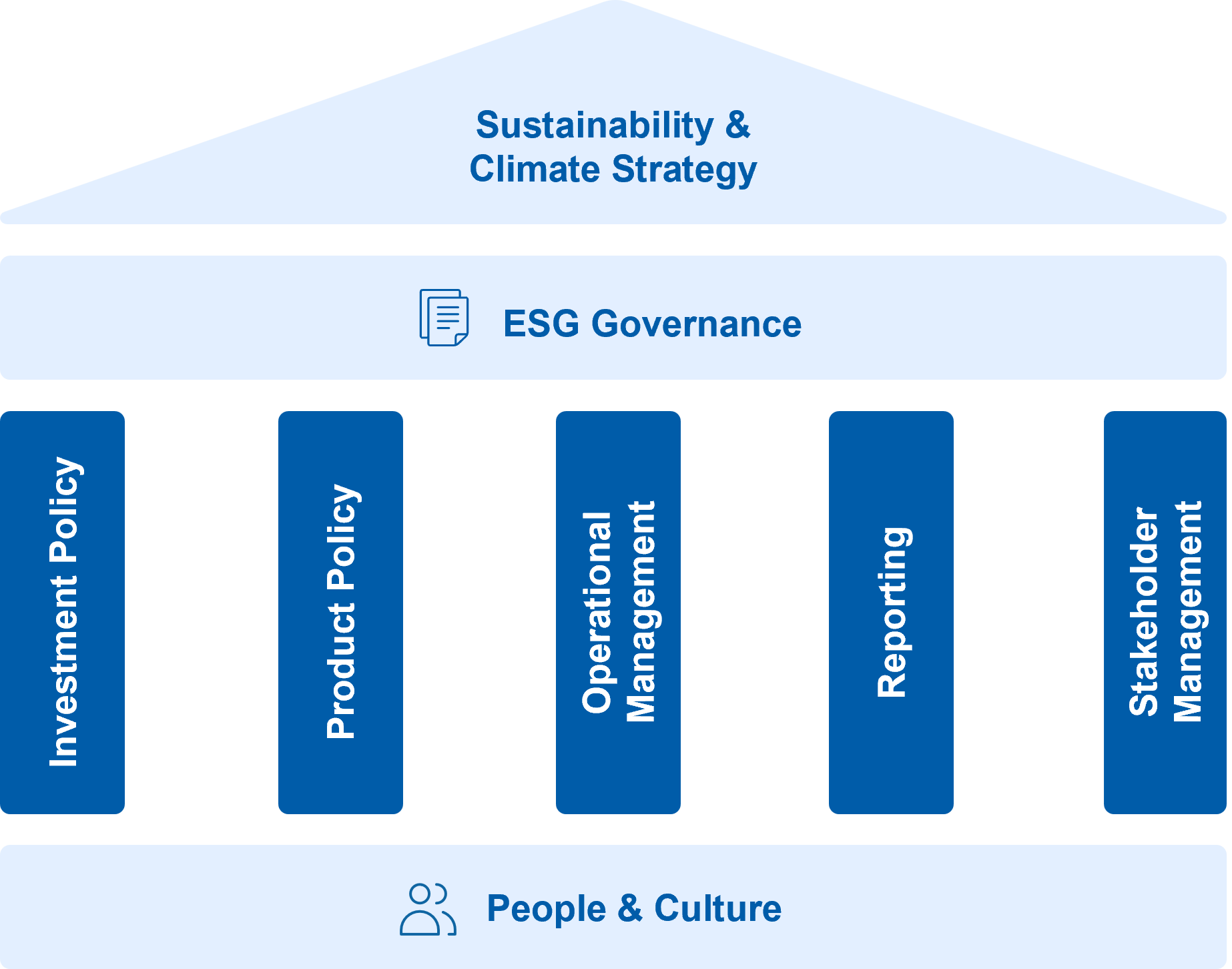
2. Environmental strategy priorities ("Environmental")
We follow the framework of the European Union Regulation (EU) 2020/852 and the 6 environmental objectives of the Taxonomy defined there when aligning our environmental goals:
• Climate change mitigation;
• Climate change adaptation;
• Sustainable use and protection of water and marine resources;
• Transition to a circular economy;
• Pollution prevention and control;
• Protection and restoration of biodiversity and ecosystems.
In addition to the first two environmental goals of climate change mitigation and adaptation to climate change, our aim is to successively incorporate all environmental goals appropriately in our business activities. We are working to improve resource efficiency in water consumption as part of operational ecology and to incorporate the circular economy in claims settlement processes. We are also increasingly incorporating these objectives into the investment policy and underwriting guidelines of our industrial customer business (Corporate Business). However, the underlying ESG information from external ESG rating databases relating to environmental objectives 3 to 6 is only in the process of being developed and standardized. Our targets and indicators will be adjusted in line with the ongoing improvement of this data. However, the main focus is on operationalizing environmental goals 1 and 2 relating to climate change.
2.1. UNIQA Climate Strategy
2.1.1. Embedding the climate strategy in the business model
The climate strategy is a special part of our sustainability strategy, as social prioritization and the necessary operationalization require clear, efficient measures and successful implementation particularly quickly. Without an intact environment, it is difficult to imagine a better life. In order to be able to provide the right services for society as an insurance company, it is necessary to take a look at future ecological conditions, because they overlay social living conditions and shape new risks. Our stakeholders are formulating expanded or new demands for themselves as well. We want to understand how they follow their ecological responsibility and engage in the essential activities.
2.1.2. Business policy and applied diligence
We base our climate change-related business policy on the “principle of dual materiality”, i.e., on the one hand taking into account the factors and consequences affecting us externally as a result of climate change (“outside-in”) and on the other hand taking into account the consequences triggered by our actions on environmental and social concerns (“inside-out”).
We assess the outside-in impacts both quantitatively and qualitatively in terms of the associated risks. To this end, we maintain our own NatCat Competence Center to directly assess the dynamics and risk dimension of climate change based on our own and purchased data. In accordance with our governance and the adopted policies, further utilization takes place in the context of product development and risk pricing as well as in risk management processes and in actuarial processes. We also assess our decision-making options and catalogues of measures with regard to any opportunities and chances in the business model.
We assess the consequences of our actions in terms of both negative and positive effects on climate-related issues and incorporate these into our decisions in the core business of investment, underwriting, and operational management. To this end, our governance follows the investment guidelines, the underwriting guidelines and the guidelines on operational ecology in the business processes (more information within the Sustainability Downloads ).
Key objectives of the Climate Strategy are:
• Pursuit of the Paris 1.5° C climate target path in investment, underwriting and operational ecology, taking into account the two EU environmental goals of “Climate Change Mitigation” and “Climate Change Adaptation”,
• Net zero emissions in the business model by 2040 in Austria and by 2050 in the Group as a whole,
• Pursuing and meeting specific science-based interim targets for 2025, 2030 and 2035 based on the Paris 1.5° Climate target path,
• Building up green investments to more than EUR 2 billion by 2025,
• Attention to avoid any negative impacts on the other EU environmental targets, • Compliance with minimum social standards.
Action plans and control
Following the definition of the sustainability strategy in 2020, concrete measures were developed in the two subsequent years to ensure that the achievement of objectives is supported and that ongoing progress can be evaluated. To this end, external ESG databases were acquired and their use anchored in the investment and underwriting processes. These databases are also used for major suppliers in Procurement & Operations Management. The specific performance indicators and key performance indicators used for this purpose can be found in the frameworks and policies of the core business areas of investment, underwriting, and operational ecology. These policies also set out the interim targets and the necessary foundations for a successful transition to a zero-emission business model (more information on the policies can be found in the Sustainability Downloads ).
Compensation policy
The linking of variable remuneration with ESGrelevant targets and key performance indicators is established at the level of the Group Executive Board and for managers in Austria below the Executive Board. From 2024, this will also be established in the remaining countries. The relevant ESG key figures relate to investment and operational ecology.
2.1.3. Climate risks and their management
The insurance industry operates in a constantly changing risk landscape with a large number of new types of risks – the so-called emerging risks. For UNIQA, analyzing and evaluating these risks is an essential prerequisite for sustainable business success. In particular, the emerging risks in the form of extreme weather events and natural disasters, such as earthquakes, storms and extreme temperatures resulting from the climate crisis, lead to unexpectedly high losses, business interruptions and loss of assets.
Management of climate risks in our business units
• In risk management, these risks are regularly modeled in scenario paths and also evaluated in internal stress tests.
• In the investment process, climate-related risks are accompanied by both qualified credit ratings (default risks, e.g., indication of stranded investments) and ESG ratings (e.g., reputation risks due to high CO2 emissions and lack of transition plans). Various KPIs (carbon risk rating, WACI, tCO₂e/million EUR GDP, tCO₂e/million EUR revenue) are included on an individual security basis and aggregated at portfolio level and in investment management.
• In the underwriting of property insurance risks, physical risks and reputational risks are primarily included as an impact of climate change. For large customers, key figures on CO2 intensity are also included in the underwriting assessment bases.
• In operations management, environmental impacts from direct CO2 emissions from mobility and building use are monitored in particular and their reduction is tracked with targets and measures, thereby minimizing reputational risks and meeting targets from ESG memberships.
The rapid pace of climate change deserves UNIQA’s attention, because the risks resulting from climate change have a direct impact on our customers and thus also on our core business as insurers. The insurance industry can play a key role in the transition to a sustainable economy - both through risk coverage for indirect and direct effects of climate risks and through targeted sustainable investments. Since insurance companies cannot act in isolation from the real economy, investments are urgently needed, especially in areas such as infrastructure and energy production. UNIQA therefore supports the efforts of the European Commission to mobilize private capital for investments in a climate-neutral Europe within the framework of the Sustainable Finance Action Plan and the European Green Deal.
2.1.4. Transition Plan until 2050: Net-zero emissions in the UNIQA Group
We are deeply committed to the 1.5° C target of the Paris Climate Agreement.
Our goal is to achieve net-zero emissions for UNIQA in Austria by 2040 and in CEE by 2050.
The key steps of our decarbonisation strategy include the phase-out of coal – already initiated in 2019, of oil (by 2030) and of gas (by 2035) in investment, our corporate business operations and our own operations management. The detailed implementation of the overall fossil decarbonization can be found for investments in the “UNIQA Guideline for Responsible Investments” and for underwriting in the “UNIQA Corporate Business Sustainability Strategy” on our Group Website .
UNIQA has developed interim targets for 2030 for the reduction of emissions in investment and own operations, which have been reviewed and confirmed by the Science Based Targets initiative (SBTi), an initiative of leading environmental and climate protection organizations (more details can be found here ).
For our investment portfolio, we have set interim targets for 2030 in four areas in accordance with the SBTi framework, which together account for 23% of our total investment volume. With our engagement activities and our decarbonisation target pathway, we will implement our science-based targets by 2027 and 2030 respectively. We have set ourselves the target of achieving a 15% reduction in our weighted average carbon intensity (WACI) by the end of 2024 compared to 2021. As part of our own operations, UNIQA has set itself the target of reducing our direct Scope 1 and indirect Scope 2 emissions by 42% by 2030 compared to the base year 2021.
We have also defined interim targets for our corporate underwriting portfolio for the first time to guide us on the path to net-zero emissions: In doing so, we are committing ourselves to a 20% reduction in insurance-associated emissions in accordance with PCAF by 2030 in Austria and 15% by 2030 in the CEE region (base year 2022).
We also pursue our climate goals as a signatory to the following international initiatives:
• PRI (Principles of Responsible Investments),
• PSI (UNEP FI Principles for Sustainable Insurance Initiative),
• NZAOA (Net-Zero Asset Owner Alliance) and
• GFA (Green Finance Alliance)
2.2. UNIQA Engagement Strategy
In terms of our commitment to ESG-related concerns, climate-related efforts are also reflected, which we pursue in 3 different core business areas, investment, underwriting and our own operations.
2.2.1. Engagement strategy in corporate underwriting
Our engagement in corporate underwriting, as in investment, is based on the Paris climate goals and our decarbonisation efforts, which we set out in our UNIQA Underwriting Standard in 2018.
The fossil fuel phase-out criteria allow us to continue to provide investments, financing and insurance to companies and support their efforts to transition away from fossil fuels in line with the Paris Agreement. UNIQA must divest from companies that continue to expand their investments in fossil fuel infrastructure or are not committed to the Paris Agreement.
UNIQA’s Corporate Business defines two directions of engagement that are relevant to our core business:
1. Engagement for decarbonisation of the underwriting portfolio
UNIQA’s engagement towards decarbonisation covers two focus areas:
• Engagement with clients related to fossil fuel in the underwriting portfolio
Stepping-out of fossil fuel related business started for our Corporate Business in 2019 with first commitments related to the coal sector. Crude oil and natural gas commitments follow from 2024 and 2025 respectively. UNIQA does not write new business in those industries, nevertheless the existing companies in our underwriting portfolio require monitoring and engagement. Existing business with fossil fuelrelated companies can remain when those companies have set science-based climate targets.
• Engagement with high-emitting corporate clients
From 2024 onwards, UNIQA Corporate Business monitors its high-emitting clients in the underwriting portfolios in all our markets. On our portfolio decarbonisation path, we focus on the most impactful companies and aim to regularly monitor their progress with own climate commitments and net-zero targets.
2. Engagement for supporting a sustainable economy
We see the potential for supportive engagement outside of regulatory requirements and/or membership obligations.
We see our further scope of action in three areas:
• Climate-related risk advisory
• Supporting transition and circular economy
• Additional direct engagement for awareness, knowledge and advisory
Details on the engagement strategy in corporate underwriting can be found in the ““UNIQA Corporate Business Sustainability Strategy” on our Group Website .
2.2.2. Engagement strategy in investment
In our engagement strategy, which we launched in 2022, we pursue both proactive and reactive engagement in direct and indirect contact with our investees. We further expanded the strategy in 2023. The engagements with companies are intended to improve the performance of our investees, particularly regarding their climate strategy, decarbonisation targets and measures. With the help of our engagements, we focus on active dialog to promote the idea of transition to prevent divestment where possible.
By proactive engagement, we mean our direct bilateral engagements with individual companies, with a focus on companies that account for 65% of our financed emissions. We intend to advance these over the next five years through bilateral discussions with the ESG teams of the respective companies about their specific targets.
By reactive engagement, we mean on the one hand collaborative engagement, which we have been pursuing since 2022 as part of our membership of the Climate Action 100+ (CA 100+) investor initiative. This involves a group of international investors engaging with a company that is among the world’s 170 most emissions-intensive companies to align its climate strategy and disclosure with science-based climate targets.
On the other hand, as of 2023, for our controversy or norms-based engagement, UNIQA has joined ISS ESG’s Norms-Based Engagement which allows investors to jointly engage with companies identified to have failed to prevent or address social and environmental controversies in line with established standards for responsible business conduct. This also includes companies involved in violations of UN Global Compact (UNGC) principles and Organisation for Economic Cooperation and Development (OECD) Guidelines for Multinational Enterprises. Specifically, this involves severe and structural breaches of normbased criteria in the areas of governance, human rights, labour rights, environment as well as bribery and corruption.
As part of our engagement, we strive to commit our partners to the following activities:
• Implementation of a governance framework that clearly articulates accountability and oversight of climate change risk.
• Taking action to reduce GHG emissions across the entire value chain, consistent with the Paris Agreement’s goal of 1.5° C as well as setting SBTi-validated targets, if they have not already done so.
• Providing enhanced corporate disclosures to enable investors to assess the robustness of companies’ business plans against a range of climate scenarios.
Details on the engagement strategy in investment can be found in the UNIQA Guidelines for Responsible Investment .
2.2.3. Engagement Strategie in our own operations
In line with our targets for achieving net-zero emissions by 2040 in Austria and by 2050 in the Group as a whole, we have started to define projects and measures with the involvement of our suppliers to ensure the ongoing reduction of our CO2 e emissions in line with the Paris 1.5° C climate target path. Reduction of CO2 emissions in operational ecology by 2030 were reviewed and confirmed by the “Science Based Targets initiative” (SBTi) and provide for a 42% reduction in our Scope 1 and Scope 2 greenhouse gas emissions (base year 2021).
The science-based goals of operational ecology and product ecology (investment & underwriting) will be managed collectively within an environmental management approach by 2025. We have defined our requirements vis-à-vis suppliers in our internal guidelines, and the discourse on adapting the upstream value chain to the Paris climate targets is an integral part of Procurement.
Likewise, the exchange, benchmarking, and joint pursuit of projects related to operations management is part of our commitment to the Raiffeisen Sustainability Initiative.
You can find more details on our Group Website .
3. Social strategic priorities ("Social")
We follow numerous international standards regarding the orientation of our social goals:
• Dealing with our own employees,
• Interaction with employees of suppliers, investees and customers,
• Interaction with affected communities, minorities and ethnic groups,
• Impact of our services on consumers and end users.
Our objective is to continuously improve the ESG rating of the “S” dimension in our own rating (in particular with regard to the treatment of our own employees) as well as in the average overall rating of our investment portfolio (“Investees Ratings”), our corporate business portfolio (“Corpo-Customer Ratings”) and major suppliers/service providers (“Supplier Ratings”).
3.1. Dealing with own Employees
Our employees are the backbone of the UNIQA community. They accompany and inspire our customers in their everyday lives and work with great dedication for our vision of a better life.
Just as the realities of work have changed massively in recent years due to digitalization, hybrid work models and new activities and jobs, the demands placed on employees have also changed. We see our employees as “inspiring coaches” who are shaping a new, sustainable future for UNIQA. Our employees and our culture are the foundation on which we build in all our endeavors.
For us, employee engagement also means empowering our employees by training them accordingly and at the same time ensuring that they can act in an undisturbed/protected environment.
The correct and appreciative treatment of people is part of our self-image and the core of our corporate culture. An exemplary attitude with regard to the protection of human rights and dignified dealings with one another are of great concern to us, especially in the area of employees. We are committed to ethnic, national, cultural, religious and sexual diversity and resolutely oppose all forms of exclusion and discrimination.
We are therefore increasingly required to demonstrate a sound understanding and practice of human rights standards and broader social issues, both in managing our risks and impacts and as an indicator of good corporate responsibility.
Therefore, at UNIQA, we are committed to structured promotions of diversity and inclusion in our community, putting people at the center of all our efforts. Likewise, maintaining health and safe working conditions (health and safety management) are important objectives, which we pursue beyond compliance with labor law provisions with targeted offers and training programs.
By joining the UN Global Compact in November 2020, we committed to upholding the United Nations Universal Declaration of Human Rights throughout the UNIQA Group. The ten principles contained therein have been incorporated into our Group-wide UNIQA Code of Conduct.
In addition to previous commitments in the areas of culture and health (sports), a further pillar is being firmly anchored at UNIQA with socially oriented projects and measures. We have set a consistent framework in our “CSR Sponsoring Strategy”, with which targeted action and thus support and part of our social responsibility is to be carried (more information regarding that topic in the Sustainability Downloads ).
3.2. Dealing with employees at suppliers, investees and customers
We have also increasingly integrated our requirements regarding the treatment of employees into our policies and decision-making principles in investment management, underwriting and our own operational management. Appropriate ESG rating processes support investment decisions, deal origination, and ongoing monitoring of these business transactions. We need to continue to expand our awareness to further strengthen the links between environmental and human rights issues in promoting a sustainable insurance business and to holistically manage the associated social risks and opportunities. This includes promoting equity and inclusion as a strong component of the transition to a just, sustainable economy
3.3. Dealing with affected communities, minorities and ethnic groups
In order to meet our fundamental requirements of respecting the human rights of affected communities, minorities and ethnic groups, it is also important to us that all processes that form the cornerstones of our sustainability strategy, such as: Investment, Product Policy, Own Operations, Reporting, and Stakeholder Management, with appropriate care in our processes and guidelines to help mitigate any negative impacts. For this purpose, we are also building on increasingly better data bases, which are made available to us by external rating agencies.
3.4. Impact of our services on consumers and end users
In order to meet our fundamental requirements with regard to the avoidance of any negative effects of our services on consumers and end users, we ensure that our guidelines and processes in investment, product policy and our own business management take appropriate care to prevent any negative effects for consumers and end users. We also place special emphasis on consulting and our information services.
4. Governance-related focal points of the Sustainability Strategy ("Governance")
This section outlines the key elements of the roles and responsibilities of the stakeholders involved in ESG governance at the UNIQA Group.
The highest body here is the Supervisory Board of UNIQA Insurance Group AG, which deals with environmental, social and employee-related issues in the body but also upstream in various committees. The Audit Committee deals in particular with non-financial reporting, the Investment Committee deals with the anchoring and pursuit of a sustainable investment policy, and the Committee for Management Board Matters deals with ESG integration in the variable remuneration systems.
4.1. Supervisery Board
The Supervisory Board is the highest supervisory body and is regularly provided with information and training on sustainability developments and the accompanying regulations in order to fulfill its duties. As a rule, it meets 5 times a year. The committees of the Supervisory Board generally meet 4 times a year.
4.2. ESG-Komitee
The ESG Committee, established in 2021, is a dedicated body that addresses environmental, social and governance (ESG) issues within UNIQA.
It consists of:
• Group CO People & Brand (Chairman)
• Group CIO & CITO Life&Health
• Group COO
• Group CFRO
• CSO Austria
• CSO Retail Austria
• Head of Corporate Business
• Head of Legal & Compliance
• Head of Group ESG Office
The committee is responsible for integrating and strengthening ESG aspects in insurance, investment and asset management activities. In addition, the Group ESG Committee also oversees the following topics:
• Implementation of the Group-wide climate strategy (including decarbonisation).
• Implementation of Group-wide environmental management
• Implementation of the Group-wide sustainability strategy
The ESG Committee meets quarterly and makes recommendations on ESG issues to the UNIQA Management Board for decision-making.
Key functions of the committee include:
• Strategic definition and continuous development of the ESG ambition for the UNIQA Group.
• Leading the Group’s ESG approach and approving the annual ESG work plan.
• Definition and prioritization of ESG issues for the Group
• Regularly inform the UNIQA Management Board about ESG issues and activities
• ESG targeting and KPI monitoring
• Topic setting for the annual Stakeholder Council
4.3. Group ESG Office
The Group ESG Office is responsible for managing the integration of environmental, social and governance (ESG) aspects into core investment and insurance activities.
In addition to integrating ESG into the UNIQA Group’s core business areas, the tasks of the Group ESG Office primarily include:
• Support for ESG guidelines and rules for UNIQA’s own investments.
• Support for ESG guidelines and rules for UNIQA insurance lines of business
• Coordinate and support the further implementation of relevant member commitments, such as the Principle for Responsible Investment (PRI), the Principles for Sustainable Insurance (PSI), the Net-Zero Asset Owner Alliance (NZAOA) and the Green Finance Alliance (GFA) throughout the UNIQA Group
• Provision of information for specialist departments on regulatory requirements, recognized ESG standards and the reporting requirements for Group Sustainability Reporting / Nonfinancial Reporting for the UNIQA Group
• Implementation of the Group Sustainability Reporting / Nonfinancial Reporting for the UNIQA Group
4.4. ESG Working Group with operational departments
The ESG Working Group brings together ESG specialists and/or representatives from various local operating units (OUs) and Group departments (Investment, Underwriting,Operations, Risk Management, Compliance, Communications, etc.).
Under the leadership of the Group ESG Office, the main task of the working group is to,
• to jointly evaluate the opportunities and risks in the European Company Alignment - in particular with regard to the New Green Deal and the Sustainable Finance Action Plan,
• analyze the accompanying regulatory measures and support proper preparation for them,
• develop and discuss projects and proposals for ESG integration in the company. The working group will enable the identification of risks and opportunities of specific proposals and provide an opportunity for all participants to comment or raise concerns regarding the feasibility (e.g., in implementation or rollout) of such plans and proposals.
The ESG Working Group meets at regular intervals (quarterly) throughout the year.
5. Group-wide coordination of ESG integration
This section provides an overview of the Group-wide ESG integration approaches and processes in selected operating units of the UNIQA Group. These units track ESG targets, action plans and KPIs across the Group in a standardized manner and moderate ESG integration in the core business regarding investment, underwriting policy and real estate management in cross-country projects.
5.1. UNIQA Corporate Business (UCB) UCB acts as a competence center for corporate transactions.
As part of UNIQA’s underwriting policy, ESG-critical business transactions are screened and evaluated in detail to enable informed decision-making. If ESG risks cannot be mitigated or impacts on the reputation of the UNIQA Group are expected, a transaction is escalated for a corporate level. In particular, coal-related transactions are subject to our decarbonisation commitment,similarly, we have defined phase-out plans for oil-based (by 2030) and for natural gas-based (by 2035) value chains (for more details see abstract “UNIQA Corporate Business Sustainability Strategy” on our Group Homepage). A systematic approach to communication with and training for underwriters ensures awareness and understanding of critical issues and sectors, as well as the processes to be applied.
5.2. UNIQA Capital Management (UCM)
Investment management is an integral part of the insurance business as UNIQA customers’ premiums are invested and converted into investment income. UNIQA Capital Management (UCM) pools and manages all proprietary assets on behalf of operating insurance companies across a range of asset classes, sectors and countries to meet long-term liabilities. As a result, UNIQA has both direct and indirect exposure to other companies, sectors and economies.
UCM acts as the central asset manager of all UNIQA’s financial assets. Execution is through management mandates between OUs within the Group. It is UCM’s belief that ESG factors are important drivers of investment performance that can only be fully realized through a truly active approach to asset management. Recognizing the value that ESG factors can bring to portfolios and UNIQA business units UCM is committed to integrating ESG factors into all investment decisions across all asset classes. The cornerstone of UCM’s investment approach is UNIQA’s Sustainable Investment Policy and collaboration with external ESG portfolio analysts. In particular, coal-related investments are subject to our decarbonisation commitment, and we have also defined phase-out plans for oil-based (by 2030) and natural gas-based (by 2035) value chains (for more details see the UNIQA Guidelines for Responsible Investment ).
5.3. UNIQA Real Estate
UNIQA Real Estate (UREM) is the strategic center for real estate expertise within the UNIQA Group. UREM develops and implements customized portfolios and investment strategies on behalf of UNIQA companies, including direct and indirect real estate investments as well as commercial real estate financing.
Environmental, social and governance (ESG) issues, such as climate change, will increasingly influence the fundamentals of real estate markets worldwide. Therefore, ESG needs to be integrated into business operations, e.g. investment processes, to increase financial returns on real estate investments and mitigate ESG-related risks for UNIQA investors.
Improvement activities aim to measure and subsequently improve the ESG performance of the UREM real estate portfolio, e.g. through pilot projects (“lighthouse projects”) and Group-wide initiatives. Examples of potential “lighthouse projects” include certified green energy procurement, certified green buildings, and various energy saving and efficiency measures. Initially recorded CO2 emissions (Scope 1 and Scope 2) from owner-occupied real estate will be reduced to net-zero by 2040 in Austria and Group-wide by 2050 in line with the Paris 1.5° C target based on science-based targets. For financial real estate (Scope 3 emissions), we are pursuing corresponding approaches and we are engaging with our tenants and legislators to implement and create the necessary framework conditions.
6. External Associations and Engagements
UNIQA is committed to several ESG-related standards and principles. Our sustainability report is prepared in accordance with the Global Reporting Initiative standard (GRI Standards 2021).
We have further committed to:
• UN Global Compact (UNGC) – joining and signing the 10 principles of the UNGC.
• CDP – joining and reporting as a signatory investor
• PRI – Signee, following the UN Principles for Responsible Investments
• PSI – Signee, tracking the Principles of Sustainable Insurance
• NZAOA – Net-Zero Asset Owner Alliance
• Green Finance Alliance Austria (GFA)
• Science Based Targets initiative (SBTi)
We also maintain contacts with ESG rating agencies and ensure timely and transparent disclosure of ESG content on the UNIQA Insurance Group AG Website.