
UNIQA Sustainability Strategy in
Corporate Business
1. Introduction
Corporate Business is one of the core areas that reflect the efforts of UNIQA Group within its sustainability strategy.
UNIQA Corporate Business (UCB) aligns its underwriting activities with the key objectives of the UNIQA Group Sustainability Strategy relevant to corporate business, namely to:
• Actively pursue a decarbonization pathway in underwriting portfolio, with a clear strategic focus on the EU environmental objectives of Climate Change Mitigation and Climate Change Adaptation;
• Achieve net‑zero greenhouse gas emissions in the underwriting portfolio by 2040 in Austria and by 2050 at Group level;
• Define, pursue and meet interim decarbonization targets for 2025, 2030 and 2035;
• Avoid material negative impacts on other EU environmental objectives, ensuring overall environmental coherence;
• Ensure compliance with minimum social safeguards and standards.
By defining impactful measures for its contribution to the key objectives of the sustainability strategy, UCB follows the “principle of double materiality”.
On the one hand, playing a vital role as an insurer to enhance companies’ resilience to climate-related risks and supporting the clients externally affected by climate change (“outside-in”). And on the other hand, considering the consequences triggered by the economic activities of the clients in our underwriting portfolio on environmental and social concerns (“inside-out”).
Sustainability developments introduce significant impacts for the corporate insurance industry, including climate change related losses, integration of ESG-related risks in the underwriting process, disclosure of sustainability-related performance, market expectations for new sustainable products and components that support sustainable economic behavior and new technologies, as well as sustainability considerations in the supply chain.
Our approach to sustainability in Corporate Business covers three main directions: strengthening climate-related risk resilience, working on underwriting portfolio decarbonization and developing new sustainable products and components.
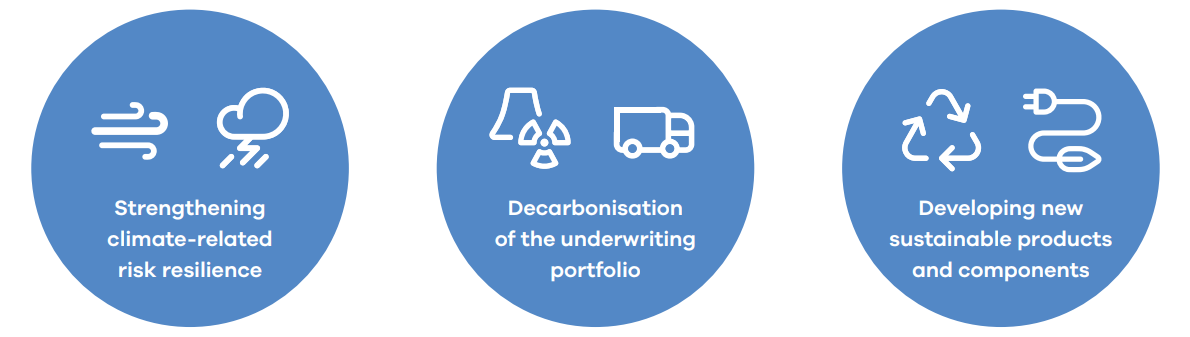
The UNIQA Sustainability Strategy in Corporate Business encompasses climate and engagement directions, designed to complement each other in all the three areas.
2. Climate risks related resilience
As insurer, we see our core role in enhancing the resilience of our clients facing the risks caused by climate change. We consistently work in three main areas strategically important for impactful support of our clients: growing competence, improving standard risk resilience measures’ quality and developing comprehensive advisory for the growing demand of companies to keep up with emerging risks related to climate change.
2.1. Climate risk-related resilience advisory
UNIQA focuses on its long-term plans for developing a structured process to provide customers with appropriate advisory support to embed mitigation measures relevant for climate risk-related resilience. For this purpose, we develop climate resilience reporting, containing climate models from experts together with organizational, construction, and technical specifications for measures.
Our customers should be able to decide on the most efficient investments in respect of climate-related risk resilience measures based on our assumptions. We embed preventive advisory as well as advisory after a climate-related risk event.
2.2. Professional advisory on climate related risks
UNIQA provides professional advisory services on climate related risks through UNIQA Sustainable the Group’s competence center for resilience. These services are delivered by interdisciplinary teams of risk engineers, resilience experts, and sustainability specialists across the UNIQA Group.
The advisory approach is based on an integrated resilience framework, combining climate related risks, sustainability aspects, and conventional operational risks, supported by broad and diverse technical expertise. Using scenario based analyses, material physical and transition risks are identified, assessed, and prioritized to derive targeted mitigation and adaptation measures.
3. ESG-related steering of the underwriting portfolio
Insurance is enabling economic activities by sharing the financial consequences of various risks, and UCB carefully steers the underwriting portfolio to make sure ESG-related factors are systematically integrated into decision-making. This includes evaluating clients‘ environmental and social footprints, governance quality, and exposure to ESG-related risks.
3.1. Underwriting portfolio evaluation
High quality ESG related data on corporate clients is essential for assessing the impact of corporate business activities. Continuous efforts are made to further enhance data availability, data management and ESG related reporting processes. Reliable and consistent data forms a critical foundation for steering the underwriting portfolio towards net zero. To ensure a comprehensive understanding of the ESG profile of corporate business, absolute greenhouse gas emissions, emissions intensity metrics, and exposure to ESG related risks are systematically assessed.
3.1.1. Insurance-associated emissions of the underwriting portfolio
As a key implementation step, third party data have been integrated into the underwriting platform, enabling the automatic assessment of new business offers with regard to absolute GHG emissions and emissions intensity. This integration supports the analysis of insurance associated GHG emissions across the entire underwriting portfolio, based on industry average data for Scope 1 and Scope 2 emissions. Insurance associated GHG emissions of the underwriting portfolio, as well as their development over time, are disclosed on a regular basis in the sustainability statement of the Group Management Report.
UCB plans to gradually improve the portfolio evaluation of all business units, including EU and non-EU countries of its presence, and to embed more primary GHG emission data upon availability.
UNIQA commitments for the underwriting portfolio quality improvement are strengthened by its membership in the Green Finance Alliance, which guides our portfolio target setting and scope of climate and engagement commitments. For more details, see “Memberships and Ratings” on our Group homepage.
3.1.2. ESG-related risks of the underwriting portfolio
UNIQA Corporate Business integrates ESG risk considerations into its underwriting process through the UCB Environmental Social Governance (ESG) Standard, which defines:
• ESG risk factors relevant for underwriting
• Evaluation criteria
• Engagement expectations for clients with elevated ESG risk exposure
All responsible employees, both internal and external, receive timely and regular training on ESG risk considerations in underwriting to ensure they are fully embedded in the processes.
Due diligence violations are followed and addressed consistently.
The ESG risk evaluation considers environmental, social, and governance dimensions, including:
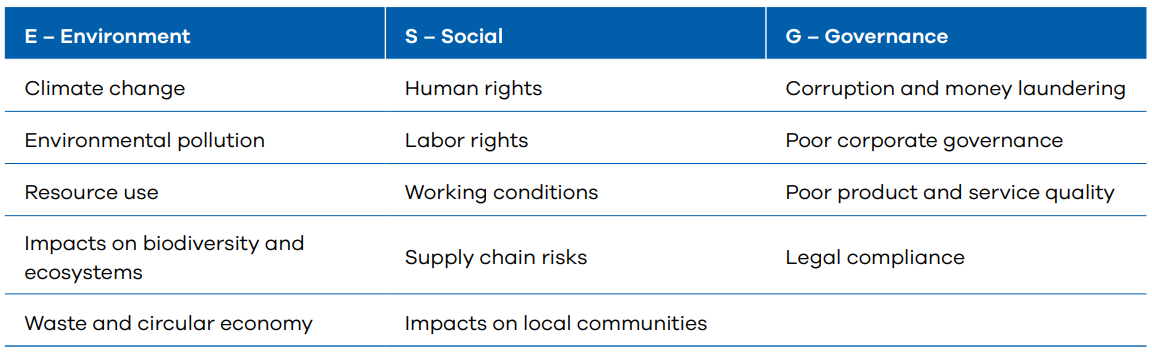
3.2. Metrics and targets
Dedicated metrics and targets support our ambitions for both working on climate-related risks resilience of our clients and developing our underwriting portfolio to reach net-zero.
UNIQA Corporate Business sets the following climate-related targets:
1. Net-zero emissions underwriting portfolio
Underwriting portfolio insurance-associated GHG emissions reach net-zero by 2040 in Austria and 2050 in the CEE region with interim 5-year targets. The detailed target setting approach is described in the “Metrics and Targets” document available on our Group homepage.
2. Stepping-out of fossil fuels
UNIQA commits to step out of fossil fuel business (coal/crude oil/natural gas), according to the decarbonization commitment’s timeplan.
3. 100% of big clients with climate targets
By 2040 all clients in our portfolio that are subject to obligatory sustainability reporting (CSRD) have set a GHG-neutrality target for their core business. Relevant metrics have been established to measure the efficiency of UCB’s progress towards its sustainability related goals. The detailed methodology is outlined in the “Metrics and Targets” document available on the Group homepage.
3.3. Underwriting portfolio decarbonization
In its pathway towards net zero emissions in the underwriting portfolio, two core strategic focus areas have been defined: the phased exit from fossil fuel related business and a dedicated focus on clients operating in high emitting industries.
3.3.1. Commitments to step-out of fossil fuel business
Coal
As of 2019, UNIQA has resigned from writing new business in coal power generation with with a coal share higher than 30% of total turnover.
Starting with 2023, UNIQA resigned from writing new business* with companies that generate more than 5% of their revenue from activities in the coal sector (exploration, production, processing, distribution, power generation, heat generation, infrastructure), as well as for new coal projects aimed at expanding coal infrastructure. This does not apply to companies that publicly commit to decarbonizing their core business in accordance with the Paris Agreement.
In 2030, UNIQA will phase-out all portfolio positions in companies that generate more than 5% of their revenue from activities in the coal sector (exploration, production, processing, distribution, power generation, heat generation) and from all coal projects, except for the companies that publicly commit to decarbonizing their core business in accordance with the Paris Agreement (time horizon: 2050, including five-year interim targets), as well as projects that are in line with the Paris Agreement.
* New business is more specifically defined as new policies for new and/or existing clients, that insure new/additional fossil fuel infrastructure. The prolongation of the existing policies, that does not enlarge the insured fossil fuel infrastructure is not classified as new business, including premium increases due to inflation and/or losses adjustments.
Crude oil
Starting with 2024, UNIQA resigns from writing new business with companies that generate more than 30% of their turnover from oil activities (exploration, production, processing, distribution, power generation, heat generation, UDW (Ultra-deep water) oil projects/ infrastructure), as well as for new conventional and unconventional oil projects, that aim at expanding the oil infrastructure. Excluded from this are companies that publicly commit to decarbonizing their core business in accordance with the Paris Agreement.
In 2030, UNIQA will phase-out all portfolio positions in companies that generate more than 5% of their revenue from activities in the oil sector (exploration, production, processing, distribution, power generation, heat generation, UDW (Ultra-deep water) oil projects/ infrastructure) as well as from all oil projects, except for the companies that publicly commit to decarbonizing their core business in accordance with the Paris Agreement (time horizon: 2050, including five-year interim targets), as well as projects that are in line with the Paris Agreement.
Natural gas
Starting with 2025, UNIQA resigns from writing new new business with companies that generate more than 30% of their revenue from natural gas activities (exploration, production, processing, distribution, power generation, heat generation, UDW (Ultra-deep water) gas projects/ infrastructure), as well as for new natural gas projects, aimed at expanding the natural gas infrastructure. Excluded from this are companies that publicly commit to decarbonizing their core business in accordance with the Paris Agreement.
In 2035, UNIQA will phase-out all portfolio positions in companies which generate more than 5% of their revenue from natural gas activities (exploration, production, processing, distribution, power generation, heat generation, UDW (Ultra-deep water) gas projects/ infrastructure) and from all natural gas projects, except for the companies that publicly commit to decarbonizing their core business in accordance with the Paris Agreement (time horizon: 2050, including five-year interim targets), as well as projects that are in line with the Paris Agreement.
For existing clients associated with coal/crude oil/ natural gas activities, an annual review is conducted to identify the presence of transition plans aligned with the Paris Agreement and to assess reported progress where feasible. The monitoring results are published in the sustainability statement of the Group Management Report.
Nuclear business
UNIQA does not write atomic/nuclear energy risks directly and/or by way of reinsurance and/or via pools and/or associations.
3.3.2. Focus on clients in high-emitting industries
Companies operating in the most high emitting industries account for a significant share of the insurance associated emissions of the underwriting portfolio. As a result, developments in these sectors are of particular relevance for achieving climate related objectives. From 2024 onwards, UNIQA Corporate Business systematically monitors regulatory developments, technological progress and innovation, industry initiatives, and decarbonization pathways across key high emitting sectors. Transition pathways in the energy, heavy manufacturing and transport sectors are considered especially critical for achieving the shared objective of limiting anthropogenic impacts on the climate.
UNIQA Corporate Business aims to closely monitor sustainability related developments among major clients operating in high emitting industries, with the objective of enabling informed and impactful engagement along their decarbonization pathways.
• Short term perspective (3–5 years):
The focus is placed on monitoring top emitting clients in the underwriting portfolio with regard to the existence, quality and evolution of their climate strategies and targets. In parallel, relevant sector specific commitments, regulatory requirements and emerging technological standards are continuously reviewed for the most GHG intensive industries represented by material business volumes in the underwriting portfolio.
• Mid term perspective (5–10 years):
Structured engagement with clients from the most GHG intensive industries is envisaged through formal written communication and/or direct dialogue. The objective is to gain a deeper understanding of clients’ sustainability journeys, including the integration of relevant climate metrics, targets and transition measures.
• Long term perspective (10–15 years):
A strategic reassessment of underwriting priorities and risk appetite is envisaged, including a potential shift away from insuring CSRD obliged companies in the most emission intensive industries—namely energy, heavy manufacturing and transportation— where such companies do not establish science based climate targets and/or fail to comply with applicable technical screening criteria, including those set out in EU Climate Delegated Act (EU) 2021/2139 for substantial contribution to climate change mitigation.
Progress against these objectives and measures is reported annually in the sustainability statement of the Group Management Report.
4. Embedding the Sustainability Strategy in the governance of Corporate Business
UNIQA Corporate Business ensures the completeness of the agenda of our sustainability-related commitments by strengthening the team with dedicated experts. Core teams are therefore enhanced with sustainability experts. The expert’s role includes fulfilling all regulatory requirements for corporate insurance, supporting product development, ensuring relevant processes’ integration, initiating IT developments, monitoring relevant regulations, standards and methodologies, and integrating UNIQA’s Sustainability Strategy into our Corporate Business environment.
To strengthen corporate underwriting portfolio steering across markets and support the effective local implementation of ESG-relevant processes and reporting, the role of ESG Advisor for corporate business has been established. The ESG Advisor plays a central part in ensuring that corporate underwriting in each business unit is aligned with sustainability-related commitments and standards, engages with clients in ESG matters, and drives relevant initiatives within the organization.
4.1. Introduction of the Pre Offer ESG Due Diligence Process
A major enhancement to UCB’s governance is the introduction of a mandatory ESG risks evaluation prior to issuing offers for significant policies. This process ensures that clients with potentially material environmental, social, or reputational impact are evaluated before underwriting decisions are made. The ESG risk evaluation includes:
• A structured review of publicly available ESG commitments
• Industry based ESG risk modelling
• Controversy screening
• A formal decision outcome: Proceed, Proceed with Conditions, or Abstain
This process is a prerequisite for finalizing underwriting decisions and ensures that UCB’s portfolio aligns with UNIQA’s sustainability commitments and minimum social safeguards.
4.2. ESG Competence Building and Due Diligence Process Controls
To support the consistent application of ESG risk considerations in corporate underwriting, UNIQA Corporate Business complements its governance framework with training activities and process control mechanisms.
ESG Due Diligence trainings are offered on a regular basis, including annually, to corporate underwriters and relevant intermediaries. The trainings cover ESG risks in underwriting, the Pre Offer ESG Due Diligence Process, and the practical application of ESG related decision criteria. Participation in the trainings is voluntary and supported by written guidance and ongoing information exchange.
In addition, adherence to the Pre Offer ESG Due Diligence Process is subject to structured process checks. These controls focus on verifying whether all underwriting cases that fall within the defined scope of mandatory ESG risk evaluation have been submitted for ESG review prior to offer issuance.
Potential violations of UNIQA’s internal ESG underwriting standard are addressed through defined internal escalation and corrective action mechanisms, supporting the consistent integration of ESG standards into the underwriting process.
5. Development of sustainable products and product components
UNIQA Corporate Business sees the urge to support our clients in both their sustainable economic growth and in their development of new sustainable technologies by providing relevant products and product components. That will be the focus for the upcoming years.
Among the areas for products’ and product components‘ development are:
1. Growth of business with renewable energy
2. Supporting circular economy: sustainable reconstruction, re-used materials
3. Further development of environmental liability components and social components of corporate insurance solutions.
New products and components are annually reported in the sustainability statement of the Group Management Report.
6. Growing sustainability awareness and knowledge
Effective advancement of sustainability objectives in corporate business requires a systematic approach to awareness building and the continuous strengthening of relevant knowledge and competencies. For this reason, training and professional development on sustainability topics form an integral part of the short and long term action framework of UNIQA Corporate Business.
In the short term, priority is given to practical aspects of implementing the climate and engagement strategy. This includes targeted training on ESG standards, updates and enhancements to underwriting systems, the integration of sustainability topics into annual training programs, and ongoing ESG related updates for a broader internal audience.
In the long term, the significant role of the insurance industry in influencing environmental outcomes is recognized. Accordingly, UNIQA Corporate Business aims to contribute to the transition towards a more sustainable economy by systematically increasing awareness of climate related issues. To support this objective, a structured and gradually expanding set of training offerings on sustainability topics in corporate insurance is being developed, covering a broad range of relevant environmental, social and governance aspects.
7. Engagement approach as part of the Sustainability Strategy in UNIQA Corporate Business
UNIQA Corporate Business defines two directions of impactful engagement that are relevant to its core business.
As part of its decarbonization commitment for the underwriting portfolio, engagement with corporate clients will be further strengthened to support timely progress. Building on its role as an insurer and risk expert and leveraging the ability to reach businesses across a wide range of industries, the focus lies on broad-based engagement with the business community. This approach aims to provide meaningful support along the shared path towards a sustainable economy.
7.1. Engagement for decarbonization of the underwriting portfolio
The portfolio’s pathway towards net zero focuses on two key areas: the gradual exit from fossil fuel–related business and the monitoring of high emitting companies. Engagement activities are structured accordingly, with an intensity that reflects the relevance and risk profile associated with each of these focus areas.
7.1.1. Engagement with clients related to fossil fuel in the underwriting portfolio
The phased withdrawal from fossil fuel–related business for UNIQA Corporate Business began in 2019 with initial commitments concerning the coal sector. Commitments related to crude oil and natural gas followed in 2024 and 2025, respectively. While no new business is entered into within these industries, existing relationships within the underwriting portfolio remain subject to structured monitoring and targeted engagement.
Existing businesses with fossil fuel related companies might remain when those companies have set science-based climate targets (time horizon: 2050, including five-year interim targets) and decarbonize their core business in line with the Paris Agreement.
Three levels of engagement are defined for interactions with clients operating in fossil fuel–related industries:
Level 1 – Information-based assessment:
Publicly available information is analyzed, including published sustainability strategies, non financial or sustainability reports, relevant policies, and data from recognized external initiatives and databases such as SBTi, Climate Action 100+, ISS ESG and comparable sources. This analysis supports an assessment of the company’s transition pathway, alignment with recognized climate standards, and the ambition and credibility of its decarbonization strategy.
Level 2 – Written engagement:
Where relevant sustainability information is not sufficiently available, an initial written engagement is initiated, primarily via intermediaries. This engagement seeks clarification on the company’s climate related commitments, transition plans, emissions reduction targets, governance structures, and implementation timelines relevant to its decarbonization pathway.
Level 3 – Direct engagement:
If the first two levels do not provide adequate insight, direct dialogue with the corporate client is pursued to address outstanding questions and to gain a clearer understanding of the company’s approach to managing climate related risks and transition efforts.
7.1.2. Engagement with high-emitting corporate clients
From 2024 onwards, UNIQA Corporate Business monitors high emitting clients in the underwriting portfolios across all markets. Within the portfolio decarbonization pathway, the focus is placed on the most material contributors, with the aim of regularly monitoring their progress in relation to climate related commitments and net zero targets, where such information is available.
As the UCB underwriting portfolio differs across markets with respect to industry exposure, a country specific approach is applied. The monitoring therefore focuses on the most significant contributors to portfolio insurance-associated emissions and their respective business activities, considering market specific characteristics. Information on selected examples of the largest contributors to total portfolio emissions is disclosed in the sustainability statement of the Group Management Report.
Engagement procedures are reviewed on an ongoing basis in line with developments in the regulatory environment and the availability of relevant data. Where appropriate, engagement tools may be further developed or applied, including direct communication, depending on the materiality of emissions and the reliability of company level emissions data. The intensity and form of engagement evolve in line with data availability and portfolio relevance.
7.2. Enlarging the scope of evaluated ESG criteria in the underwriting portfolio
UCB integrates ESG-related criteria into client evaluation in line with data availability, market practice, and relevant international standards. In 2023, the UCB Environmental Social Governance (ESG) standard was introduced into the standard underwriting process. A mandatory pre-offer ESG risk evaluation process for significant policies was introduced in 2025.
The ESG risk evaluation follows the similar engagement logic applied in the fossil fuel sector:
• Monitoring
When clients are assessed based on industry average data, monitoring includes the review of publicly available information such as sustainability strategies, non financial reports, relevant policies, and data from external providers.
• Direct communication in critical cases
In cases involving proven legal incidents or material ESG concerns, direct communication is initiated to ensure that the client’s operations align with core international standards on ESG-matters.
If a severe or repeated critical incident is identified - particularly those affecting life, health, human rights, or causing significant environmental harm - it will be assessed whether the company has publicly demonstrated appropriate mitigation measures.
Possible decision outcomes:
• Mitigation measures confirmed or not confirmed, but the issue is non critical: proceed with offer;
• Mitigation measures are not confirmed and the issue is severe (e.g., human rights violations, work safety failures, child/forced labor, discrimination, major environmental harm): abstain business or case escalation according to UCB ESG Standard. Engagement with the client may follow to understand planned mitigation measures.
UCB will continue to expand the scope of ESG related data assessed, including social and governance risks (Minimum Social Safeguards), critical incidents, and indicators covered by the European Sustainability Reporting Standards (ESRS).
Updates on the expanded scope are reported annually in the sustainability statement of the Group Management Report.
7.3. Engagement to support a sustainable economy
UNIQA Corporate Business recognizes that its positive impact extends beyond regulatory requirements and formal sustainability initiatives. Given the diversified sectoral composition of the corporate underwriting portfolio, UNIQA Corporate Business is positioned to contribute to the transition towards a sustainable economy in ways that go beyond insurance specific mandatory commitments.
In this context, supportive engagement is structured around three complementary areas:
Climate related risk advisory
UNIQA holds extensive expertise in the assessment of physical climate risks as well as in mitigation and adaptation measures. This expertise is progressively made available to a broader external audience through professional advisory services, with the objective of strengthening corporate clients’ resilience to climate related risks.
Support for transition and the circular economy
UNIQA Corporate Business is continuously developing sustainable insurance products and product components. This includes the introduction of preferential terms and conditions that support sustainable choices, such as sustainable reconstruction measures or the use of reused and recycled materials.
Engagement to enhance awareness and knowledge
UCB supports awareness building and knowledge development on sustainability topics through selected training, information and exchange formats, primarily addressing intermediaries and relevant stakeholders. The focus is placed on facilitating knowledge transfer and fostering informed consideration of sustainability related aspects.
Last updated: May 2026