Sustainable Investment Management
To achieve our net-zero target by 2050, the rapid and complete decarbonisation of the economy is essential.
Decarbonisation Strategy
The decarbonisation strategy pursues the goal of phasing out coal and oil by 2030 and natural gas and nuclear energy by 2035 at the latest and continuously reducing the emissions intensity (WACI) of investments.
UNIQA made a commitment in 2019 to gradually exclude coal from its investments. In the case of direct investments in companies, we exclude not only issuers that are active in coal mining, but also those that generate energy from coal.
Furthermore, from 2025, additional coal-related restrictions have been implemented for direct investments in coal processing and heat generation. The UNIQA Group's coal phase-out policy and the phase-out plan for other fossil fuels and nuclear energy are set out in the decarbonisation strategy.
Further information on decarbonisation in investments can be found here:
As part of our memberships in the United Nations Net-Zero Asset Owner Alliance (NZAOA) and the Austrian Green Finance Alliance (GFA), we are committed to gradually decarbonising our investment portfolio to align with the Paris Agreement as much as possible and to achieve net-zero emissions in our investments by 2050 across the Group.
The successful validation of our climate interim targets by the Science Based Targets initiative (SBTi) in 2023 further enhances our sustainability strategy in investments.
Further information can be found in the Science Based Targets Initiative summary.
Phase-out from coal, oil, natural gas and nuclear energy
Targeted decarbonisation, engagements, risk assessments and sustainable investments promote climate-friendly transformation and strengthen the ESG performance of the portfolio.
Further information on decarbonisation in investments can be found here:
By working with our specialised data provider ISS (Institutional Shareholder Services), we can carry out a comprehensive analysis of our investments in relation to various sustainability factors. We need this data on our investees to ensure our exclusion and phase-out strategy, which sets the following limits:
Coal
- Implementation of coal exclusion criteria since 2019.
- Since April 2022, no investments in third-party investment funds that hold positions in any company whose involvement in thermal coal mining exceeds 10% of its revenue.
- Since 2025, no direct investments or financing of companies or projects that generate more than 5% of revenue from activities in the coal sector, including coal production (extraction), processing and electricity generation. In addition, a separate revenue threshold of 5% applies to the generation of heat from coal.
Oil
- Since 2023, no direct investments or financing of new unconventional oil projects (shale oil, oil sands and Arctic oil) involving activities in the oil sector, including oil production (extraction), processing, energy (power and heat) generation.
- Since 2025, no new direct investments in or provision of new financing to conventional projects or companies that generate more than 30% of revenue from activities in the oil sector, including oil production (extraction), processing and electricity generation. In addition, a separate revenue threshold of 30% applies to the generation of heat from crude oil.
- By the end of 2030, UNIQA will have phased out all direct investments in companies and projects that generate more than 5% of revenue from activities in the oil sector, including oil production (extraction), processing and energy (power and heat) generation.
- Companies with SBTi-certified climate reduction targets are exempt.
Natural Gas
- As of 2026, UNIQA will not make new direct investments in or provide new financing to natural gas projects or for companies that generate more than 30% of their revenue from activities in the natural gas sector, including gas production (extraction), processing and electricity generation. In addition, a separate revenue threshold of 30% applies to the generation of heat from gas.
- By the end of 2035, UNIQA will have phased out all direct investments in companies and projects that generate more than 5% of their revenue from activities in the natural gas sector, including gas production (extraction), processing and energy (power and heat) generation.
- Exceptions apply to companies with SBTi-certified targets or full taxonomy alignment from revenue or CapEx. Projects are exempt if they show full taxonomy alignment from revenue or CapEx.
Nuclear Energy
- Since 2025, no new direct investments in or provision of new financing for new projects in the energy sector that use nuclear fission to expand nuclear power infrastructure.
- By the end of 2035, UNIQA will have phased out all direct investments in companies that generate more than 5 per cent of their revenue from activities in the energy sector that use nuclear fission, and from all projects whose purpose is to produce energy from nuclear fission.
- Exceptions are granted for companies with SBTi certified targets in place or companies that conduct fully EU Taxonomy-aligned activities in terms of revenue and CapEx. Projects are exempt if they show full taxonomy alignment from revenue or CapEx.
Engagement strategy for sustainable investments
With its engagement strategy, the UNIQA Group is in direct and indirect contact with its investees through both proactive and reactive engagement. The engagements with companies are intended to improve the performance of our investees, particularly with regard to their climate strategy, decarbonisation targets and measures. Through our engagements, we focus on active dialogue to promote the idea of transition in order to prevent divestment wherever possible.
By proactive engagement, we mean direct bilateral engagement with individual invested companies. The aim is to support and guide these companies to significantly reduce their greenhouse gas emissions, implement more sustainable business practices and increase their disclosures. Targeted measures for the companies with the highest greenhouse gas emissions have the greatest positive impact on UNIQA’s climate targets.
By reactive engagement, we mean a collaborative engagement in which a group of international investors work with companies that are among the world’s most emission-intensive companies to align their climate strategy and disclosure with science-based climate targets (Climate Action 100+).
As part of our engagement, we endeavour to convince our investees of the following activities:
- Implementation of a governance framework that defines responsibilities and oversight obligations for climate risks.
- Measures to reduce greenhouse gas emissions along the entire value chain in line with the Paris 1.5°C climate target pathway, as well as the setting of SBTi-validated targets, if not yet set.
- Transparent disclosure to show the resilience of the corporate strategy to various climate scenarios.
Strategy for Sustainable Investments
Through sustainable investments, UNIQA finances companies that contribute to reducing emissions or social projects.
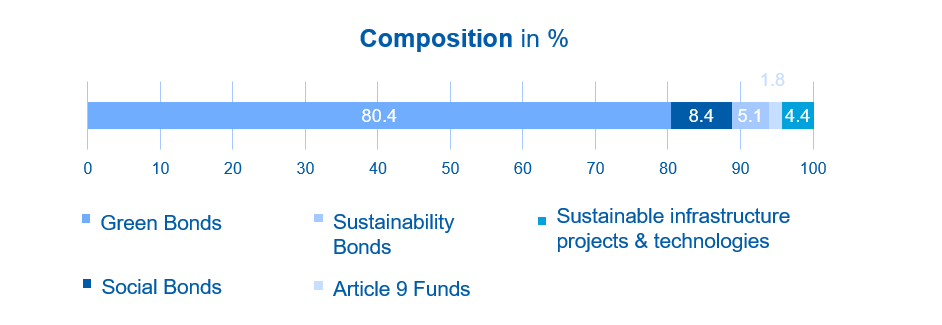
As part of its membership of the Net-Zero Asset Owner Alliance, UNIQA has set itself a target volume of 2 billion euros in sustainable investments by 2025. This target was already exceeded in 2023 and was further expanded to 2.5 billion euros in 2025.
The share of sustainable investments in the total portfolio thus amounts to 11.1% in 2025 (2024: 11%) and, as can be seen in the chart, is broken down as follows:
Statement by UNIQA Capital Markets GmbH on the Principle Adverse Sustainability Impacts of investment decisions according to Art 4 SFDR (EU 2019/2088)
According to the EU Disclosure Regulation Art. 4 SFDR, financial market participants are obliged to publish
- a report on the impact of principal adverse impacts on sustainability factors and
- a statement on due diligence strategies in relation to these impacts.
UNIQA Capital Markets GmbH is the internal financial service provider of the UNIQA Group, due to the lack of its own homepage, the report is published on the homepage of the UNIQA Group.
VÖNIX
The VÖNIX (VBV Austrian Sustainability Index) is an Austrian sustainability index that includes companies listed on the Vienna Stock Exchange that are leaders in social and ecological criteria. The index was introduced in 2005 and is reconstituted annually based on a comprehensive analysis. The UNIQA Group is part of this index and was rated with a ba in the indicative rating, corresponding to a score of 1.7.