
UNIQA Climate Transition Plan
Shaping our Future:
UNIQA on the Journey to Climate Transition
Last updated: December 2024
1. Foreword
At the UNIQA Group, we firmly believe that a shared commitment to a sustainable future is essential to ensure the well-being of our society and our planet. Our central idea of “living better together” inspires us to take responsibility not only for our customers but also for future generations
This publication presents the first decisive steps taken by the UNIQA Group on the path towards a netzero future. The goals and measures presented are the result of intensive reflection, strategic planning and continuous collaboration with our partners and stakeholders. However, this document is not an endpoint, but a dynamic plan that will evolve in line with the demands and challenges of the times.
We are aware that the transition to a net-zero economy will require time, commitment, and innovation. Therefore, we commit to regularly reviewing our progress and evolve our plan to achieve our target of net-zero emissions in the underwriting business and in our own operations by 2040 in Austria and across all business areas (investment, underwriting, own operations) Group-wide by 2050. This will also strengthen the trust of our stakeholders. With this plan, we invite you to join us on this journey thus together we can create a more sustainable and fairer future.
During the preparation of this publication, a benchmark by means of an extensive peer analysis was evaluated, and various frameworks were utilised. Organisations and initiatives such as the Transition Plan Taskforce (TPT), Glasgow Financial Alliance for Net Zero (GFANZ), UN High Level Expert Group (UN HLEG), International Platform on Sustainable Finance (IPSF) of the European Commission, Carbon Disclosure Project (CDP), World Wide Fund for Nature (WWF), Partnership for Carbon Accounting Financials (PCAF), Taskforce on Climate-related Financial Disclosures (TCFD), IFRS: ISSB Standards and the US SEC have each produced guidelines for developing a transition plan, including its structure and content, which are reflected in this document.
2 Strategy and Ambitions of the UNIQA Group
With the strategic programmes UNIQA 3.0 – Seeding the Future (2021-2024) and the continuation UNIQA 3.0 – Growing Impact (2025-2028), the UNIQA Group began a transformation in 2020 to increase customer orientation, which also includes the expansion of services in areas adjacent to insurance. It is our strategic orientation along the UNIQA 3.0 World View 2030, which summarises the most relevant megatrends and their impacts: low interest rates and the shift of economic power; demographic and social change; innovation and digitalisation; and climate change and sustainability. These trends significantly influence the lives of all individuals, including employees and customers, as well as the environment as a whole. Sustainability is therefore firmly emmbedded in the UNIQA Group strategy.
The UNIQA Sustainability Strategy pursues a holistic approach and combines economic endeavour with a clear ecological and social commitment to the environment and society. The UNIQA Group is constantly refining its sustainability strategy and aligning its goals and measures even more closely with established international and national frameworks. Progress is reported on a regular basis, among other channels, in our annual sustainability report and on the UNIQA Group Website.
The UNIQA Sustainability Strategy is based on five cornerstones (ESG investment policy, ESG product policy, sustainable operational management, transparent disclosure and stakeholder management), which rest on a foundation consisting of our employees (people) and our corporate culture. The framework is provided by the anchoring and integration of ESG in the governance of the UNIQA Group.
The UNIQA Climate Strategy is the heart of the Group Sustainability Strategy, because protecting the environment by reducing CO2 emissions requires the rapid operationalisation of clear and efficient measures. As an insurer, the UNIQA Group clearly takes responsibility for direct as well as indirect emissions – those caused by financing, investments and property insurance in the real economy. The agreement reached at the UN Climate Change Conference in Paris in 2015 to limit global warming to a maximum of 1.5 degrees Celsius serves as an unequivocal goal. The first major step in this direction was taken at the beginning of 2019 with the adoption of the UNIQA Decarbonisation Guideline.
In addition to the decision to phase out coal in investment and underwriting, this also included the creation and implementation of a comprehensive sustainability strategy, which came into force at the end of 2020. This included joining the Net-Zero Asset Owner Alliance (NZAOA) in October 2021, which was accompanied by a renewed commitment to the Paris 1.5 degrees Celsius target, as well as the commitment to net-zero emissions, which are to be achieved in Austria (underwriting, own operations) by 2040 and across the Group in all business areas by 2050 (investments, underwriting, own operations). Joining the Green Finance Alliance (April 2022) and the associated commitments, round off the UNIQA Group memberships. A key milestone on the path to net-zero emissions was the validation of science-based interim targets for 2027 and 2030 by the Science Based Targets initiative (SBTi) in 2023, both for the investment portfolio and for the own operational management.
Key objectives of the UNIQA Climate Strategy:
• Pursuit of the Paris 1.5 degrees Celsius climate target pathway in investment, underwriting and operational ecology, considering the two EU environmental targets ‘Climate Change Mitigation’ and ‘Climate Change Adaptation’
• Net-zero emissions in the business model (underwriting, own operations) by 2040 in Austria and by 2050 in the Group as a whole (investment, underwriting, own operations)
• Pursuit and realisation of specific sciencebased SBTi interim targets for 2030 based on the Paris 1.5 degrees climate target pathway
• Maintaining green investments at more than 2 billion euros by 2025
• Consideration of any negative impact on other EU environmental targets
Science-based target setting: SBTi-validated interim climate
In 2023, Group-wide interim climate targets for four areas of the investment portfolio, which accounted for 23 per cent of the total investment volume in the baseline year 2021, as well as the 2030 interim targets for the Group’s own operational management. This is an important step for the UNIQA Group to optimise the alignment of the portfolio and the CO2 emissions of its own operations (Scope 1 and 2) with the 1.5 degrees Celsius climate target pathway. SBTi is a co-operation between the Carbon Disclosure Project (CDP), United Nations Global Compact (UN GC), World Resource Institute (WRI) and World Wide Fund for Nature (WWF). The aim of the SBTi is to promote an ambitious climate policy by setting science-based climate targets.
Our science-based targets at a glance:
• Commitment to reduce absolute GHG emissions in Scope 1 and Scope 2 by 42 per cent by 2030 (compared to the base year 2021)
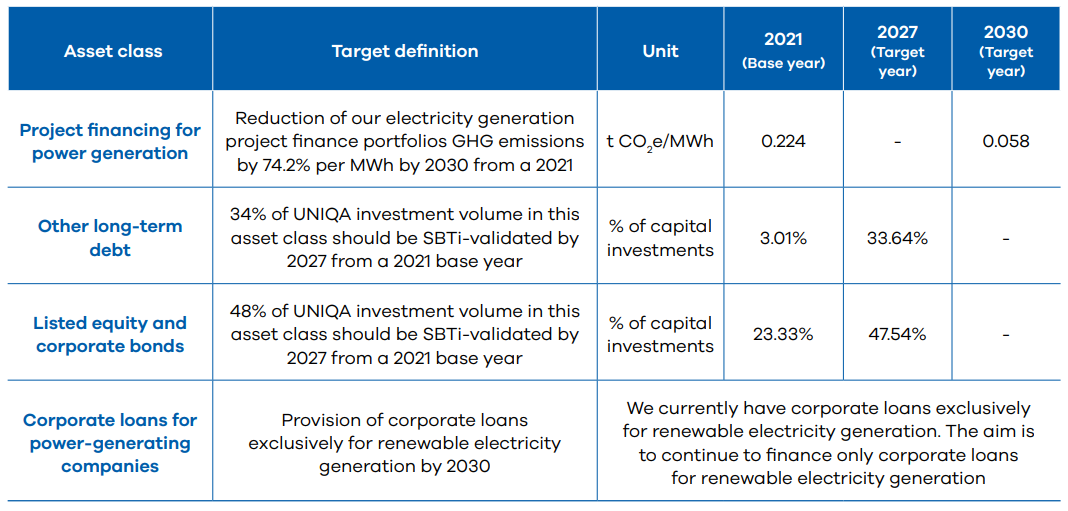
• Commitment that 48 per cent of the portfolio of listed equities and bonds will have science-based targets by 2027, measured by invested value
• Commitment that 34 per cent of the portfolio of corporate loans will have science-based targets by 2027, measured by invested value
• Commitment to finance only electricity generation from renewable energy sources in the corporate loan portfolio by 2030
• Commitment to reduce GHG emissions from the project finance portfolio for electricity generation by 74.2 per cent / MWh by 2030 (compared to the base year 2021)
Details of the validated targets can be found on the SBTi Website .
3 Our path to net-zero emissions
In terms of our Group-wide UNIQA Climate Strategy, the focus is on achieving net-zero emissions in the business model (underwriting, own operations) by 2040 in Austria and by 2050 in the Group as a whole (investment, underwriting, own operations).
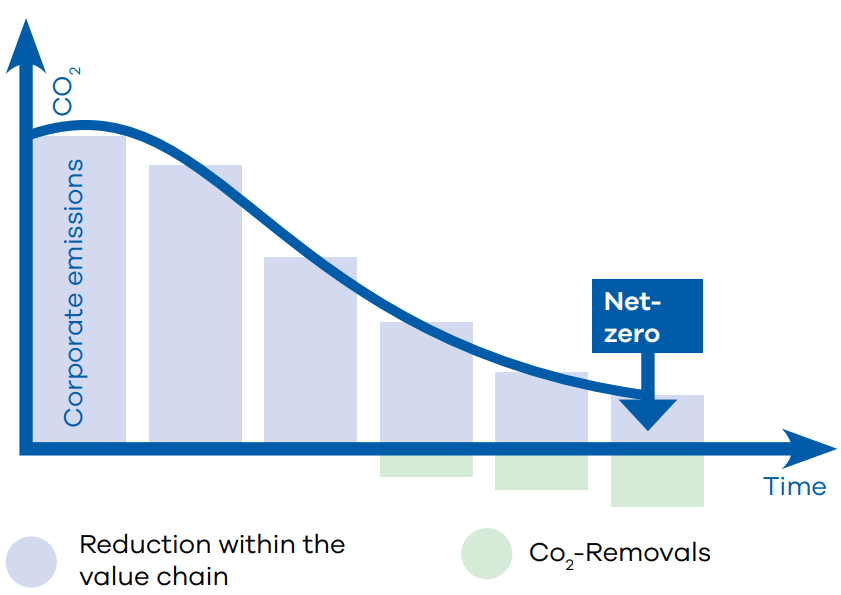
We define net-zero emissions as (a) the reduction of our Scope 1, 2 and 3 CO2 emissions to zero at best or to a residual level that is compatible with achieving net-zero emissions at global or sectoral level in corresponding scenarios or sector paths within the 1.5 degrees Celsius target; and (b) the neutralisation of all residual emissions by the net-zero target year and all greenhouse gas emissions subsequently released into the atmosphere.
To achieve this goal of net-zero emissions, comprehensive action plans are required in the various core areas in which the respective target achievement is implemented. Necessary aspects such as the creation of a sustainability and climate strategy as well as a decarbonisation strategy, an engagement strategy, the validation of science-based interim targets and comprehensive integration into governance have already been developed and implemented.
The focus of our next steps will be on creating and developing transparent action plans to achieve our interim targets through to net-zero emissions. Even if specific action plans are not yet available in all business units, successes can already be recorded regarding the UNIQA decarbonisation strategy in the various core areas. The following sub-chapters summarise our climate-related strategies, targets and measures already implemented.
3.1 Investment activities
3.1.1 Investitments as asset manager allocations
Since 2018, the UNIQA Group has been implementing steps to establish a sustainable investment process. These began with the development of specific KPIs and sustainability targets for investments, which form the basis for the
UNIQA Guidelines for Responsible Investment .
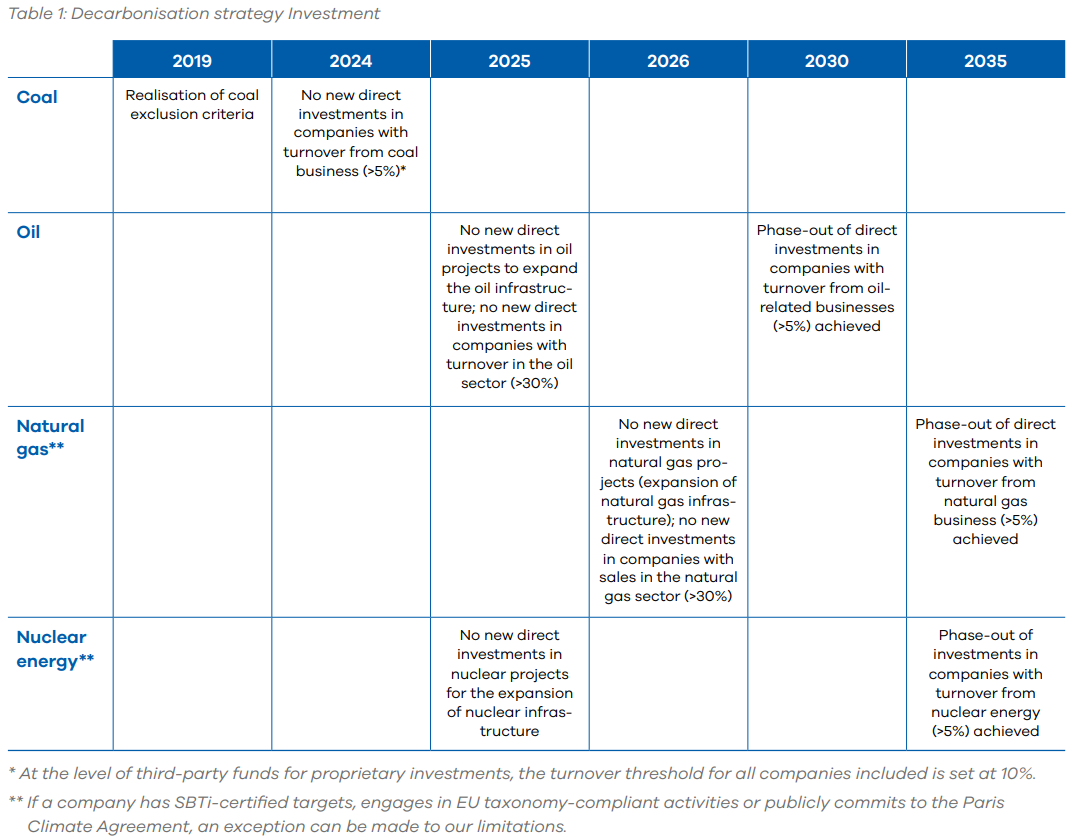
In 2019, the UNIQA Group decided to exclude coal businesses from its investments. This excludes not only investments in corporate issuers that are active in coal mining and coal production, but also in electricity generation from coal. The sale of investments in coal-related companies was completed by the end of 2019. Since then, the UNIQA Group has also restricted investments in oil and gas-related transactions. Details on our fossil phaseout plan can be found in our
Statement on Decarbonisation
.
Intermediate targets in the investment portfolio: Science Based Targets (SBTi target Letter)
Our SBTi interim targets comprised 23 per cent of investments in the base year 2021. The portfolio share comprises the activities required by the SBTi guidance. The remaining portion of the investments consisted of 19 per cent optional and 58 per cent outof-scope activities.
Decarbonisation strategy for investments
As part of its membership in the United Nations Net-Zero Asset Owner Alliance (NZAOA) and the Austrian Green Finance Alliance (GFA), the UNIQA Group is committed to the gradual decarbonisation of its portfolio to be optimally aligned with the Paris 1.5 degrees Celsius climate target pathway and to achieve net-zero emissions from investments across the Group by 2050. The successful validation of the interim climate targets by the Science Based Targets initiative (SBTi) in 2023 further rounds off the sustainability strategy in investments. By 2030, the UNIQA Group aims to gradually transform its portfolio and reduce Scope 3 emissions, which are largely due to investments in Scope 3.15 (investments), by encouraging investees to set their own science-based climate targets. By working with the specialised data provider ISS (Institutional Shareholder Services), the UNIQA Group can carry out a comprehensive analysis of investments in relation to various sustainability factors. This data on the investees is required, among other things, to ensure the exclusion and phase-out strategy, which intends for the following limitations (Table 1). Additionally, the UNIQA Group will gradually extend the scope of its coal policy to customer-related products, such as unit-linked life insurance, savings, and pension products. The current policy can be found on the UNIQA Group Website in the Sustainability Downloads .
3.1.2 Strategy for Sustainable Investments
The UNIQA Group finances issuers that contribute to emission reduction or to social projects. It is guided by the following sustainability definitions for each asset class: Green, Social and Sustainability Bonds in accordance with the International Capital Market Association (ICMA) Principles. Funds are classified as Article 9 (dark green funds) under the EU Sustainable Finance Disclosure Regulation (SFDR) and are therefore considered investments pursuing a sustainability objective as defined by the SFDR. In addition, qualified investments in infrastructure projects are included in our sustainable investments. The Sustainable Investment Strategy is outlined in the UNIQA Group Responsible Investment Standard. Investments made are regularly monitored by the UNIQA Group Risk Management.
3.1.3 Engagement strategy
In the engagement strategy, the UNIQA Group pursues both proactive and reactive engagement though direct and indirect contact with investees. Engagement with companies is intended to improve the performance of our investees, particularly regarding their climate strategies, decarbonisation targets and related measures. Through engagement, we focus on an active dialogue to encourage transition efforts and, where possible, avoid the need for divestment. We also pursue controversial or standards-based engagement led by ISS (Institutional Shareholder Services), which enables investors to engage with companies that commit serious and structural violations of normative criteria in the areas of corporate governance, human and labour rights, the environment, bribery and corruption or fail to take measures to respond appropriately and take countermeasures.
These include violations of the principles of the UN Global Compact (UNGC) and the Guidelines for Multinational Enterprises of the Organisation for Economic Co-operation and Development (OECD). More information on the UNIQA engagement strategy can be found in the current sustainability report on the UNIQA Group Website in the Sustainability Downloads .
3.2 Insurance activities
3.2.1 Corporate Business
Since 2019, the UNIQA Group has refrained from underwriting new business in coal-fired power generation with a coal share of more than 30 per cent of total sales. In 2023, the UNIQA Group refined its ESG underwriting strategy in a Group-wide standard. The UNIQA Corporate Business Sustainability Strategy is available on the Group Website in the Sustainability Downloads .
The UNIQA Corporate Business Sustainability Strategy comprises three main directions. To correctly prioritise sustainability-related goals and activities, the UNIQA Group is guided by the commitments of the GFA (Green Finance Alliance) and the PSI (UNEP FI Principles for Sustainable Insurance).
1. Strengthening the resilience of corporate customers to climate-related risks
Due to its special characteristics, the insurance industry is heavily affected by climate change-related losses, which has an impact on both our company and our corporate customers. The increasing frequency and severity of extreme weather events poses a significant risk. UNIQA Corporate Business advises companies on how they can strengthen their resilience to climate risks and overcome the challenges they face as a company
UNIQA Sustainable
The subsidiary UNIQA Sustainable Business Solutions, founded in 2024, supports corporate customers in risk issues, transformation and ESG topics. UNIQA Sustainable supports individual and large companies in strengthening their resilience through active risk management and harmonising their sustainability strategies with the legal framework. Companies can utilise the services independently of a UNIQA insurance contract.
2. Work on the decarbonisation of the underwriting portfolio
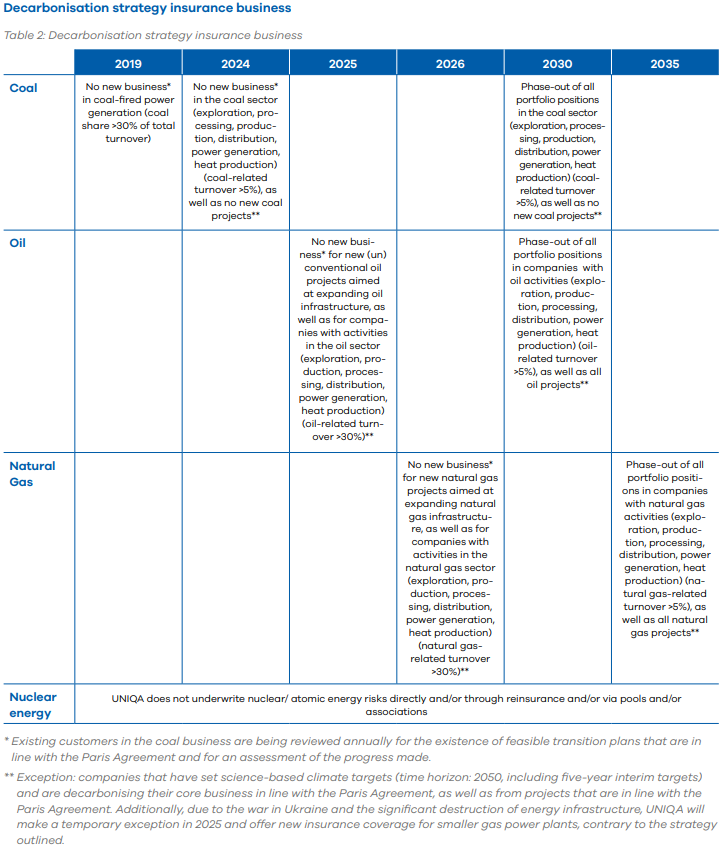
Pursuing the Paris 1.5 degrees climate target pathway in underwriting is one of the UNIQA Group most important goals. As described in detail in the decarbonisation strategy, no more new business has been concluded with customers with coal activities (since 2019); in addition, the phase-out of oil (by 2030) and gas (by 2035) in the corporate customer business is planned in detail. Details of our fossil phase-out plan can be found in Table 2 or in our Statement on Decarbonisation .
3. Development of new products and product components with a focus on sustainability
UNIQA Corporate Business is committed to supporting corporate customers not only in their sustainable economic growth, but also in the development of new sustainable technologies through new innovative products and product components. The ambition is to focus on the circular economy, which includes the sustainable rebuilding and reuse of components in major industries. Environmental liability components and social components of corporate insurance solutions are the focus of potential developments.
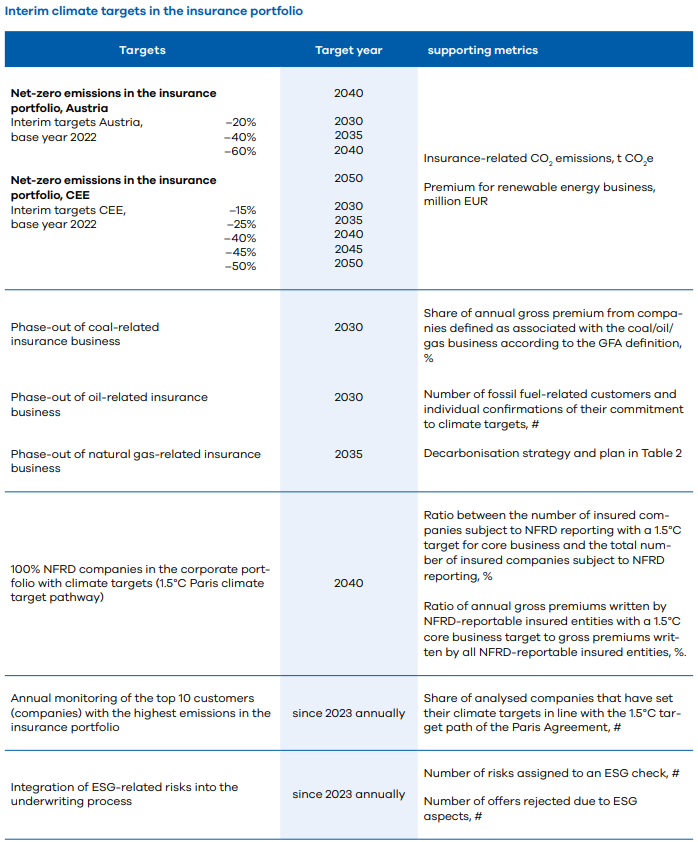
Interim climate targets in the insurance portfolio
Decarbonisation strategy insurance business
3.2.2 Private customers (Retail Business)
In line with the current UNIQA 3.0 Strategy, sustainability is at the centre of retail product development. In Austria, sustainability aspects are already firmly embedded in the advisory approach and the product development process across all insurance lines, therefore the range of sustainable insurance products and the best possible advice meet the growing demand. This joint effort ensures that environmental, social and governance aspects are integral parts of the development process to create sustainable products. Each product development is based on a structured, transparent process that is mapped in the internal Product Development Process Policy and acts as a standard for the product development process. An internal review mechanism, introduced in 2022, ensures that every product development in Austria is analysed and evaluated from an ESG perspective. In this way, ESG-related topics such as the amount of taxonomy-eligible premium shares or possible KPIs for external ESG ratings become visible at an early stage of product development. Market research activities are used to determine the sustainability preferences of strategic customer target groups. The results are incorporated into the product development process, ensuring customer-centricity in ESG-related topics.
The UNIQA Group is also gradually integrating sustainability aspects into its insurance products on the international market, and thereby demonstrating its commitment to risk management and sustainable development. The retail products offered include a range of ESG features that meet customer needs and promote sustainable practices.
The development of a Group-wide retail strategy focussing on ESG and specifically integrating it into the product development process, is currently under development and will be finalised in 2025.
3.3 Activities in our own operations
The measures to reduce the UNIQA Group’s own CO2 emissions are based on the application of international certifications and standards in dealing with suppliers and on the optimisation of internal environmental management. The UNIQA Group is increasingly using renewable energies and reducing CO2 emissions by consistently conserving resources and promoting low-emission mobility.
At Group level, the process for calculating and validating science-based climate targets in accordance with the SBTi was successfully completed in 2023. These targets not only align our investments with the Paris 1.5 degrees Celsius climate target pathway, but also the greenhouse gas emissions from our own operations (direct Scope 1 emissions and indirect Scope 2 emissions from purchased electricity and heat).
In the SBTi-validated interim target, the UNIQA Group commits to reducing absolute GHG emissions in Scope 1 and 2 by 42 per cent by 2030 (compared to the base year 2021).
The initial focus is on our largest core market Austria. In 2024, UNIQA Austria carries out an initial comprehensive evaluation of Scope 1 and Scope 2 emissions for owner-occupied buildings at fully consolidated Group level and improve the data quality in the course of 2025 to be able to derive a strategy for achieving the SBTi targets with action plans from around 2026 (development of SBTi-compliant action plans). The strategy should enable UNIQA Austria to achieve net-zero emissions in Austria by 2040 and in CEE by 2050.
Our internal environmental management is based on our commitment to the Paris climate targets, which were operationalised with an initial milestone and action plan for all sales locations in Austria in 2022.
This plan comprises the following pillars:
• Sourcing exclusively ecolabel 46 certified green electricity from 2024
• Increase energy efficiency in our building by at least 33 per cent by 2040, compared to 2019
• Expansion of photovoltaic capacity to at least 600 kWp by 2035
• Phase-out all oil and gas heating by 2035 at the latest
• Transition to 100 per cent electric vehicles in the company fleet by 2030 in Austria and Group-wide by 2035
With these measures, UNIQA Austria aims to reduce greenhouse gas emissions from sales buildings in Austria by approximately 71 per cent by 2040. As UNIQA Austria will continue to rely on district heating, which currently always includes a fossil fuel component, a reduction of 100 per cent is currently not feasible.
Business ecology – EMAS environmental management system for the core market of Austria
Large companies can reduce their directly caused CO2 emissions through the sustainable organisation of their own business premises. Successful models such as energy monitoring, the photovoltaic campaign and the promotion of e-mobility are constantly being developed at UNIQA Austria, as are comprehensive hybrid and remote working models, the promotion of video conferencing and subsidies for various public transport tickets in Austria.
With the adoption of an environmental policy, the implementation of seven internal EMAS environmental audits and the development of technical expertise, UNIQA Austria has laid the first important foundations for the introduction of an EMAS environmental management system at the sales locations in Austria. The Eco-Management and Audit Scheme is an environmental management system that serves to ensure compliance with environmental regulations and reduce the environmental impact of a company. Continuous assessment and reporting are mandatory, and progress is verified by external audits. Our goal of being recognised as an EMAS-certified company was successfully achieved in 2024.
3.4 “Going the last mile”: Target setting methods and compensations
The UNIQA Group uses scientifically based methods, such as the Science Based Targets initiative (SBTi) methodology, to set medium and long-term targets for the core areas of investments and own operations. These methods are constantly being evaluated and further developed.
In this sense, the UNIQA Group acts according to the principle of “avoid, reduce, compensate”. First and foremost, the consumption of (fossil) energy and the associated emission of greenhouse gases are avoided as far as possible. Certain shares and origins of energy (e.g. electricity mix) cannot always be verified, controlled or replaced; in this case, however, the aim is to reduce fossil fuels and replace energy sources sustainably. The focus of UNIQA Group is clearly on these two aspects and, as explained above, there are already extensive decarbonisation plans and strategies in the various core areas.
However, it should be borne in mind that scientifically sound studies also show that it will not be possible to achieve net-zero emissions through avoidance and reduction alone. It will therefore be necessary to remove greenhouse gases from the atmosphere to limit the global temperature rise to 1.5 degrees Celsius. While the UNIQA Group is currently focusing primarily on reducing and avoiding greenhouse gas emissions, we recognise the relevance of looking at alternatives and other options (compensation/removal of greenhouse gas emissions) for the subsequent phase. It is therefore also important for the UNIQA Group to follow along and keep track of the discussions about compensation. We are endeavouring to continuously improve our understanding in the broadest sense.
4. ESG in the UNIQA Governance
Sustainability measures only develop their transformative power if they are implemented transparently and comprehensibly. At the UNIQA Group, this requirement is met through strong governance for embedding and anchoring ESG in the UNIQA corporate culture, policies, products and activities. There are also clear responsibilities, well-founded stakeholder engagement and comprehensive reporting and ratings from renowned agencies.
Relevant actors and roles in relation to the ESG integration within the UNIQA Governance include:
• Statutory involvement of the Supervisory Board in sustainability reporting
• Comprehensive sustainability management, including a coordinating Group ESG Office, ESG experts in various operating units and specialised departments in Austria, and strategic ESG coordinators in international business units
• Group ESG Committee, composed of members of the management, the heads of the core business units, and the Head of ESG Office
• ESG in the remuneration strategy as an incentive and measure for the Management Board of the UNIQA Group and managers in the Austrian core market
• External audit of the sustainability report through independent verification since 2017
• Mandatory publication of a (consolidated) nonfinancial report in accordance with the Austrian implementation of the EU Directive on Non-Financial Reporting (2014/95/EU) since 2017
UNIQA Group Risk Management also plays a central role regarding the ESG integration and, above all, the ESG reporting. The goal of UNIQA Group is to protect customers from risks, minimise these risks by bundling them, generate corporate profits and ensure risk-oriented decisions. The UNIQA Group risk management monitors developments in sustainability and analyses their impact on the insurance company. The risk strategy is regularly reviewed and discussed in the Risk Committee. The UNIQA Group Risk Management System is based on the Group Risk Management Policy that defines sustainability risks. These risks are not considered as a separate category, but rather as a general risk classification and can have a significant negative impact on assets, liabilities, financial position or reputation. The system considers short, medium and long-term impacts, metrics and targets in terms of sustainability.
Process flow:
1. Risk identification: the risk catalogue contains sustainability risks that are reviewed annually in the internal control system (ICS).
2. Risk assessment & scenarios: defined climate scenarios from the NGFS (Network for Greening the Financial System) are used to analyse the impact on investments and NatCat damages.
3. Risk monitoring: ESG-related investment profiles of the international subsidiaries are continuously monitored, and limits are set to improve the ESG profile and reduce transitory risks.
4. Risk controlling: a risk minimisation plan is drawn up for each significant residual risk.
5. Risk reporting: sustainability risks are integrated into the most important internal and external reports and are updated regularly. Details on ESG Integration can be found in the current Sustainability Report, which is available on the UNIQA Group Website in the Sustainability Downloads .
5. Stakeholder engagement
In order to respond to current and future challenges and opportunities, the involvement of and cooperation with various stakeholders is crucial. The UNIQA Group must understand their needs to be able to respond appropriately (e.g. suitable products and services). To improve its sustainability and climate strategy, activities and reporting, the UNIQA Group regularly interacts with stakeholders through direct contact, joint projects, events and surveys. Our stakeholder engagement is focussed on four core stakeholder groups that significantly influence or are influenced by the core business: Customers, employees, investors and the public.
Customers
As one of the leading insurance companies in Central and Eastern Europe, we have a special responsibility towards the environment and society and therefore always have the needs of our approximately 17 million customers in mind. Engagement in the form of various processes enables us to drive forward the further development of our products and services in terms of sustainability. This includes both our business customers in the corporate business and our private customers in the retail business and is a central element in the product development process. You can read more about our engagement with our customers in relation to ESG in Chapter 3.2 Insurance activities.
Employees
Our employees are the most important capital for the success of the UNIQA Group. Based on the motto ‘living better together’, we want to be one of the most attractive employers in the financial sector. Our goal is to create a work culture of mutual support, active engagement and collaboration across conventional boundaries to keep the fluctuation rate low and strengthen the commitment and productivity of our employees.
In our workplace, we want people to grow, develop and become the best version of themselves. By investing in their development, promoting diversity and introducing new working models, we are improving our organisational capabilities and contributing to a more sustainable and equitable future, because social issues make all the difference. ESG is not only concerned with the environmental aspects of sustainability and how they are anchored in governance, but also with social aspects. In this respect, the Group-wide strategy for justice, equity, diversity and inclusion (JEDI) forms the basis for all activities and is also part of the UNIQA 3.0 programme for the future. A policy was drawn up and rolled out for the entire Group to create commitment and clear responsibilities. The policy is reviewed annually and revised as necessary to take account of any changes to the legal basis and other developments in the UNIQA Group. In our core markets, responsible contact persons have been appointed and entrusted with JEDI agendas.
The seven overarching goals of the UNIQA Strategy for Equity, Equality, Diversity and Inclusion are as follows:
• Equal pay for work of equal value
• Promoting equal opportunities by increasing the proportion of women in management positions
• Strengthening generation management
• Promoting a work-life balance
• Utilising internationality and cultural diversity from all UNIQA countries as a strength
• Better inclusion and support of people with disabilities
• Respect for the sexual orientation and identity of all people
Investors
The exchange with our investees is intended to improve their performance, especially regarding their climate strategy, decarbonisation targets and measures. With the help of our engagement activities, we focus on an active dialogue that is intended to promote the idea of transition to prevent the step of divestment wherever possible. The UNIQA Group engagement strategy in relation to investees has already been explained in Chapter 3.1. Investment activities.
Public
As we firmly believe that the protection of environmental, social and governance issues can only be achieved through joint efforts, the UNIQA Group is a member of many global sustainability initiatives. The continuous exchange of knowledge, increasing transparency, developing joint solutions and integrating best practices are of central importance to us. These memberships underline our commitment to responsible behaviour that goes far beyond legal requirements. A list of our memberships can be found here .
6. The path into the future
To keep pace with the changing times and take account of changing conditions and risks, the UNIQA Group will continue to focus on further developments of ESG criteria, sustainability goals and strategies as well as the development and implementation of specific action plans and measures. These aspects are essential as they can ensure that the UNIQA Group can respond to current challenges and achieve sustainable economic and social success.
6.1 Possibilities, opportunities and potentials
Even if non-financial disclosure and sustainability reporting are always associated with effort, change and control, they also offer potential and opportunities, especially in the long term. We are convinced that sustainable management pays off from a business perspective: companies that prioritise sustainability will remain competitive in the future. In addition, there are already studies that show that a focus on ESG engagement correlates positively with a company’s profitability; in particular, (listed) companies realise additional shareholder value through this focus on ESG engagement if they are already outperforming in terms of their key financial figures (growth and profitability)*. It is generally assumed that long-term benefits such as cost minimisation or increased efficiency are associated with the integration of ESG. This is reflected within the UNIQA Group, for example, in the remuneration strategy, which is also linked to ESG criteria.
However, stakeholders must not be forgotten in terms of opportunities and potential: With the focus and implementation of sustainability, such as in the form of image, brand, but also the design of green products and services are associated with reputational gain, brand value and customer conviction or loyalty. Social sustainability must also be considered regarding non-financial reporting. The company’s commitment and endeavours are also reflected in the satisfaction and motivation of its employees, who are given the opportunity to participate in sustainable business practices. More about the UNIQA stakeholder engagement, our employee satisfaction and further insights into sustainability in the UNIQA community can be found in various documents on the UNIQA Group Website: Sustainability Downloads.
Additionally, we also view the global, and particularly the EU-wide efforts (Green New Deal) to promote sustainability and make reporting on non-financial matters mandatory as a positive development in the UNIQA Group. A key role of sustainability concerns and the disclosure of non-financial activities of companies, as well as their transition planning, is related to the CSRD (Corporate Sustainability Reporting Directive), which is likely the most significant development regarding disclosure and reporting. However, other regulations such as the EU Taxonomy and the CSDDD (Corporate Sustainability Due Diligence Directive) are also highly relevant. Especially in the financial and insurance sectors, the SFDR (Sustainable Finance Disclosure Regulation), IDD (Insurance Distribution Directive), and Solvency II are worth mentioning.
*Doherty, R.; Kampel, C.; Koivuniemi, A.; Pérez, L. & Rehm, W. (2023): The triple play: Growth, profit, and sustainability. McKinsey’s Strategy & Corporate Finance and Sustainability practices. McKinsey & Company.
Whelan, T.; Atz, U.; Van Holt, T. V.; Casey Clark, C.; Salazar, P.; Liu, Z. & Bruno, C. (2021): ESG and Financial Performance: Uncovering the Relationship by Aggregating Evidence from 1,000 Plus Studies Published between 2015–2020. NYU Stern: Center for Sustainable Business, Rockerfeller Asset Management.
6.2 Challenges
The UNIQA Group will do its utmost to contribute to limiting global warming to 1.5 degrees Celsius and to pursuing the set goals toward net-zero emissions. At the same time, we are aware that the UNIQA Group will face many challenges along the way. Three key challenges related to the transition to net-zero emissions will be transparently highlighted here.
1. External dependencies
In order to achieve the set sustainability goals, the UNIQA Group, as a financial service provider, is also dependent on external factors that are beyond its direct control. For example, this includes the policies and actions of the government, which are necessary to ensure that the power grid is decarbonized. The behaviour and decisions of private customers to adopt a CO2-reduced lifestyle, such as driving an electric car, are also important factors for changes in the insurance portfolio. While this can be encouraged, the decision ultimately remains with the customers.
2. Social aspects and ensuring a just transition
Social aspects and a just transition to a climate-neutral economy are crucial, as a purely ecologically focused transition to net-zero emissions will not suffice. The Paris Agreement emphasizes that the transition must be both ecologically and socially just to consider the needs of particularly affected regions and vulnerable groups. The UNIQA Group is committed to social sustainability and aims to balance social disadvantages while creating new development opportunities. This is ensured through responsible investments, strict underwriting guidelines, and adherence to human rights standards. Our commitment to the UN Global Compact underscores our obligation to uphold human rights across all business activities. The ten principles contained therein have also been incorporated into the Group-wide UNIQA Code of Conduct.
3. Complexity and inaccuracy of climate data
Setting climate goals is complex due to inaccurate and incomplete data. Different data sources, lack of reporting, and varying calculation methods make risk assessment and data collection difficult, especially in investments. The UNIQA Group also faces these challenges, particularly in biodiversity, and plans to integrate climate and nature conservation more closely. The Natural Catastrophes Competence Centre (NCCC) of the UNIQA Group develops customised risk models based on its own historical data to better understand and manage the impacts of natural disasters.
7. Disclaimer und time horizon
This document represents an initial step toward a transition plan. The concrete development of measures is an ongoing process and will be the focus of the coming years. Our journey to climate transition will be reviewed and updated annually. Various entities are involved in this process: the Group ESG Office is responsible for coordinating the content provided by the different business units and publishes it on the UNIQA Group Website following approval by the Management Board. Progress and details related to ESG measures are disclosed annually in the latest sustainability report in accordance with CSRD/ESRS. Feedback can be submitted to the Group ESG Office at esgoffice@uniqagroup.com .
This document does not yet constitute a complete Transition Plan in accordance with the European Sustainability Reporting Standards (ESRS) of the Corporate Sustainability Reporting Directive (CSRD). It outlines the approach and the further steps towards a comprehensive transition plan.
Disclaimer on Forward-Looking Statements: This first Transition Plan contains statements relating to the future development of the UNIQA Group. These statements represent estimations based on information available at the time of publication. If the underlying assumptions do not occur, the actual events may vary from the results currently expected. As a result, no guarantee can be provided for achieving the targeted results.