Group of people Group of people Group of people
Group & Business

“An ageing society has more to insure”

● 20.10.2026 ● 5 minutes reading time

Demographic change is affecting our pensions, our working lives and our society. For an insurance company, this presents opportunities simply because older people tend to be more conservative and therefore more inclined to take out insurance. 

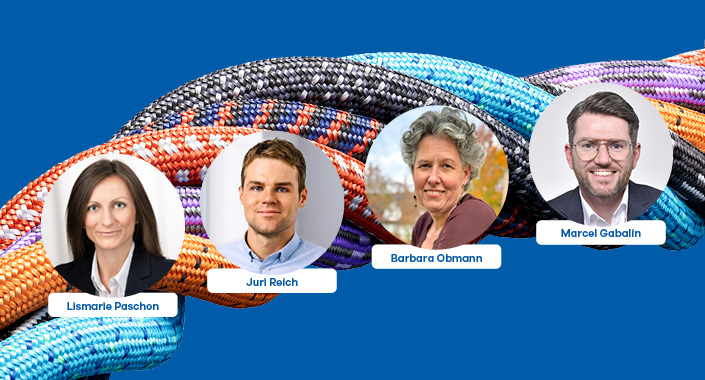
Specifically, the need for preventative care is increasing, as is, in many cases, the desire for it. That said, there is still room for improvement when it comes to personal responsibility in Austria. Barbara Obmann, General Agent in Burgenland, Lismarie Paschon, Group Organisational Development, Juri Reich, In-house Consulting, and Marcel Gabalin, Market Intelligence & Transformation, discuss the challenges and levers of a sub-trend with significant impact in this Megatrend interview.

An ageing society has more to lose and therefore more to insure.

Juri Reich

What characterises the demographic change, which is listed in UNIQA’s World View between the megatrends of ‘Health’ and ‘Social change’, and what is our personal perspective on this?

Juri: Demographic change is a cross-cutting issue. An ageing society requires a different kind of healthcare, a different funding model, and new ways of life are emerging. This trend is extremely persistent, powerful and predictable – a trend to which we must adapt.

Marcel: By 2070, there will be just 1.8 people in work for every pensioner; today, the figure is still 3.1. On top of an ageing population, the birth rate is falling, currently standing at 1.3 children per woman. The pay-as-you-go system is reaching its limits. We will have to expand the second and third pillars of pension provision, and private health insurance will grow significantly.

Juri: A great deal will depend on whether we manage to extend the period of our youth – something to which lifelong learning also contributes.

Marcel: Instead, we’re ageing in a state of above-average ill health; financially, we’re also worse off, and some of us sitting here will be dependent on care staff in old age. 

Barbara, is this trend already becoming apparent amongst customers today?

Barbara: To me, it feels today much like the period between the Middle Ages and the Renaissance. This is particularly true of the 30- to 40-year-old generation. Individuality is becoming more important – partly due to AI – people want to pursue their calling, enjoy their work, continue to be challenged, and they don’t have the prospect of retirement on their minds. They want prevention and personalised healthcare, they’re mindful of their diet, they think about their mental health – all so they can live well, happily and contentedly. Unfortunately, the media is currently stoking fears: everything is getting worse – fear of losing income, fear of needing long-term care.

Marcel: Yes, fear is being fuelled by the media; hospital waiting times – or rather, the reporting on them – are a massive driver of new business, currently accounting for twelve to thirteen per cent. However, private expenditure on prevention isn’t that high, and when it comes to financial provision, we have the problem of distant benefits anyway, because retirement is always more or less a long way off.

Barbara: This stems from our history in Austria. We live in a very social system with a high standard of healthcare and a high level of pension provision compared to other countries.

People in Austria often do not yet recognise the need for long-term care insurance.

By 2070, there will be just 1.8 people in work for every pensioner; today, the figure is still 3.1.

Marcel Gabalin

What products are currently resonating with people that long-term care insurance isn’t, at least for the time being?

Marcel: We have good products within our healthcare ecosystem; we launch new savings products every spring and we’re moving into funded financial provision. Long-term care insurance isn’t just a niche product for us – it’s growing at a rate below inflation across the entire sector.

Barbara: Customers prefer to take out life insurance, as this allows them to dispose of the capital freely and thus gives them greater flexibility. 

Demographic change is a predictable trend, so it is also predictable that we will all work for longer. But how will we work?

Lismarie: We need to combine the valuable experience of long-serving staff with the ability to adapt to new situations. That’s the real superpower. Artificial intelligence can help, but we need the initial impetus to use it in a way that actually gives me more time. I like to compare AI to a pocket calculator. Just like it, AI will become indispensable. This adaptability isn’t a question of age, but of mindset and openness. Most roles will change. Employees who work with AI will replace those who don’t.

Juri: The advantage of AI is that it’s intuitive; people should find the transition easier these days.

Barbara:  But at the same time, older employees are currently often being made redundant by companies for cost reasons, meaning a great deal of specialist knowledge is being lost. To give a comparison: in New Zealand, people work well into old age, albeit often for just a few hours a week. There, we see one of the lowest rates of dementia internationally, because people are challenged and also feel needed.

Lismarie: Yes, it is precisely these employees who remain relevant by combining their skills with valuable practical experience and staying open to change. In a skills-based organisation, it’s individual abilities that count.

People want prevention and personalised healthcare – all so they can live well, happily and contentedly.

Barbara Obmann

But will we have enough work for everyone?

Juri: It would be a false promise to say that everyone can work until the age of 75. We need to look at both the micro and macro levels: what is good for the individual, and what is good for a listed company. AI will automate a great deal; certain jobs will disappear. The productivity gains from AI must be distributed more fairly. We’ll have different career paths – not a continuous working life – but will take on care work in between, undertake further training, and then return to work. And we won’t be retired for 30 years.

Lismarie: This is a social change that will take place gradually. If people are to remain in work for longer in future, we need not only to develop the pension system further but, above all, to introduce flexible working models that take account of different stages of life, resilience and individual needs.

Barbara: Our pension system doesn’t currently encourage people to work longer.

Marcel: We need tax incentives to make it attractive for employers to retain staff for longer. And tax incentives for the second and third pillars of financial provision.   

Much depends on the state, but much also depends on us – what aces does UNIQA have up its sleeve?

Marcel: In health insurance, we offer ‘Access to Care’ when the state system is overburdened. Through the MavieMed clinics, we hold a market share of around 35 per cent in Austria. Thanks to the appointment availability provided by LARA, we’re already a key player in healthcare provision in Vienna. We’re a credible employer when it comes to balancing work and family life.

Lismarie: We don’t have complete control over all the labour market policy conditions, but we can provide impetus. Our greatest leverage lies in remaining an attractive employer and creating working conditions that appeal to people at different stages of life in the long term and keep them within the company.

Juri: Demographic change also presents an opportunity for us, at least in the short term. An ageing society is more conservative and prefers to invest its money in life insurance. It has more to lose and therefore more to insure.

The interview was conducted by Barbara Morawetz. Photos: UNIQA graphic, private


This adaptability isn’t a question of age, but of mindset and openness.

Lismarie Paschon

About the interviewpartner:

Lismarie Paschon brings extensive consulting experience from numerous transformation projects and has been shaping organizational development at the UNIQA Insurance Group since March 2026. She focuses particularly on how AI is changing our working world and how people and organizations can be empowered to actively shape this change and build the skills needed for the future.

Juri Reich heads the In-House Consulting department within the Strategy and Transformation division. Like all members of his team, his professional background is in management consulting. Juri’s work focuses on our group-wide strategy as well as on numerous other strategically relevant projects across various business units.

Barbara Obmann has been working as an independent insurance agent with her own client office for 30 years. Her work centers on clients and their individual needs and life situations. She provides personalized, one-on-one support to both private clients and small and medium-sized businesses. Her goal is to find a suitable insurance solution that provides security and offers the best possible protection for clients’ personal and business lives.

Marcel Gabalin has been shaping strategic transformation at UNIQA for six years, drawing on his experience as a former strategy consultant. His focus is on viewing demographic change not merely as a challenge, but as a starting point for new pension, customer, and growth strategies.

Interviewpartner