UNIQA Sustainability Strategy in Corporate Business
Metrics & Targets
nur auf Englisch verfügbar
This document describes dedicated sustainability-related metrics and targets for the UNIQA Corporate Business, including insurance-associated GHG emissions performance and metrics used to monitor our progress in respect of climate and engagement commitments of the Group.
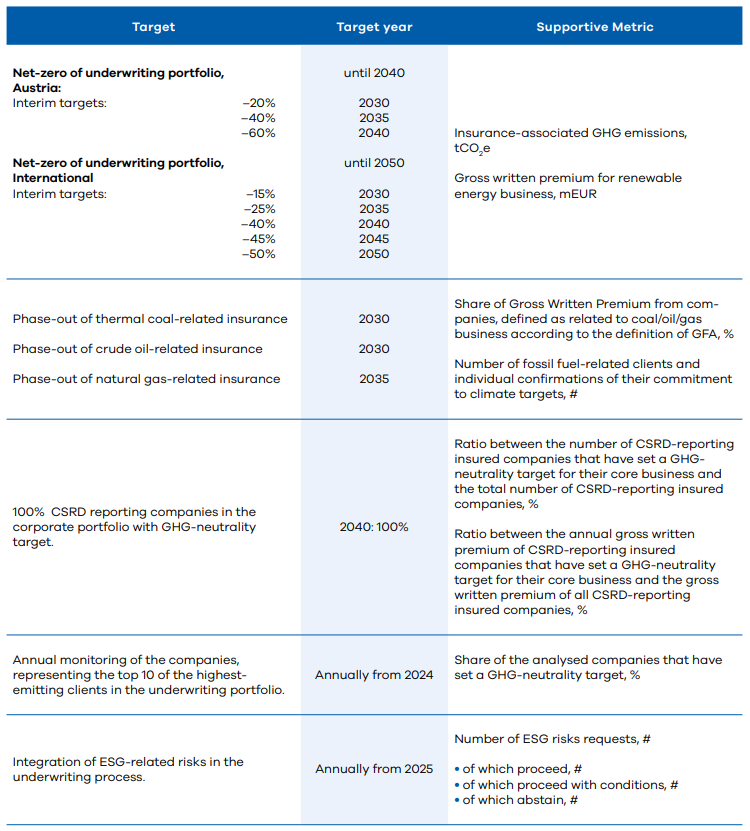
On its sustainability journey, UNIQA Corporate Business sets the following climate-related targets:
1.1 Net-zero emissions in the underwriting portfolio
We aim that the insurance-associated GHG emissions of our corporate underwriting portfolio reach net-zero by 2040 in Austria and 2050 in the CEE region, with 5-year interim targets. In January 2024, in support of our net-zero emissions ambition, we have set targets to reduce the insurance associated emissions of our underwriting portfolio (absolute scope 1 and 2 emissions of corporate clients) by 60% by 2040 compared with a 2022 baseline on a net basis for the Austrian portfolio, and by 50% by 2050 compared with a 2022 baseline for the international portfolio.
We monitor our progress using the key metrics described further below. We define net-zero emissions for Corporate Underwriting portfolio as (a) the reduction of our Scope 1, 2 GHG emissions to zero at best or to a residual level that is compatible with achieving net-zero emissions at global or sectoral level in corresponding scenarios or sector paths within the 1.5 degrees Celsius target; and (b) the neutralisation of all residual emissions by the net-zero target year and all greenhouse gas emissions subsequently released into the atmosphere.
Targets for insurance-associated emissions
Our calculations and targets are based on the current economic activities’ structure of the portfolios, current structure of the premium share split between the markets and existing national decarbonisation commitments. We understand that crucial processes and developments, driven by governments, society and businesses are not within our control. We commit to spare no effort to adjust our measurements and activities accordingly to keep the decarbonisation ambition level high enough.
The following non-life lines of Corporate Business are included in the calculation of the insurance-associated GHG emissions: Property, Enginnering, Liability, Transport, Motor. SME segment is not included in the scope. Insurance-associated emissions are calculated upon the PCAF (Partnership for Carbon Accounting Financials) methodology, using primary emissions’ data where possible and external data for GHG emission intensity per million-euro revenue for each industry, based on the industrial classification codes. The result is expressed in tons CO2 equivalent and is annually reported in the sustainability statement of the Group Management Report.
Interim targets are defined based on a weighted combination of the premium share of individual markets within the total international underwriting portfolio and the respective local ambition levels for greenhouse gas emission reductions.
Local ambition levels reflect the targeted percentage decrease in GHG emissions and are derived from national long-term climate strategies aligned with Paris Agreement commitments. They further take into account the sectoral composition of the corporate business by economic activity, as well as the strategic objective to progressively increase the share of renewable energy‑related business within the underwriting portfolios.
1.2 Stepping-out of fossile fuels
UNIQA commits to step out of fossil fuel business (coal/ crude oil/natural gas), according to the decarbonsation commitment’s time-plan. Details can be found in the Statement on Decarbonisation and a summary is given in the table below.
We introduced the monitoring of the premium share of fossil fuel related business back in 2019 for coal related clients. We monitor all UNIQA Group coal/crude oil/ natural gas share of gross written premium starting with the data collection of the year 2022.
The following non-life lines of business are included in the calculation of fossil fuel business analysis: Property, Engineering, Liability, Transport, Motor. Together with the premium share from fossil fuelrelated business and gradual step-out of insurance for those clients, we monitor the climate targets and sustainability strategies of the existing clients of those industries and engage with them in case of insufficient information. The number of clients, representing fossil fuel business according to the definition given in the Green Finance Alliance (GFA) Handbook , and grouping them by the factor of presence/absence of climate targets compatible with the Paris Agreement, are annually reported in the sustainability statement of the Group Management Report starting with the reporting year 2023.
1.3 100% of big clients with climate targets
As a member of GFA, UNIQA commits as well to follow the climate goals of corporate clients, that are subject to non-financial reporting, according to the CSRD. Our goal is that all such clients in our portfolio must have set a GHG-neutrality target for their core business by 2040.
According to the target definition in the GFA Handbook, we measure and report our progress annually in the sustainability statement of the Group Management Report:
• Ratio between the number of CSRD-reporting insured companies that have set a GHG-neutrality target for their core business and the total number of CSRDreporting insured companies.
• Ratio between the annual gross written premium of CSRD-reporting insured companies that have set a GHG-neutrality target for their core business and the gross written premium of all CSRD-reporting insured companies.
2. Supportive metrics
In parallel with the core metrics and targets, we also report the results of the integration of ESG-related risks evaluation in our underwriting process. Namely, we monitor the number of offers that were assigned to the ESG-related risks evaluation, the number of requests that could be proceeded with or without conditions (f.e. further monitoring), and number of ESG risk evaluation requests that have been abstained. The evaluation is based on the UCB ESG Standard criteria and process. S
tarting from the year 2025, the results of the monitoring can be found in the annual sustainability statement of the Group Management Report.
The absolute net annual premium volume for renewable energy businesses is another metric that supports our core net-zero targets. It includes net annual insurance premium of business for the
• companies whose main economic activity is energy production from renewable energy sources (wind power, solar power, bioenergy, hydroelectric power)
• companies that produce renewable energy infrastructure (solar panels, wind turbines)
• companies that enable a full cycle of renewable energy infrastructure (design, installation, maintenance, repair/replacement)
• renewable energy infrastructure itself for other companies.
From 2024 onwards, the top ten clients contributing most significantly to insurance‑associated GHG emissions in each market are analysed with regard to the existence and development of climate strategies and THG-neutrality targets.
This metric supports the implementation and monitoring of the net‑zero underwriting ambition by providing a structured, market‑level view of decarbonisation progress, taking into account the composition of the underwriting portfolio and the concentration of exposure in high‑emitting sectors.
In particular, the analysis focuses on industries with structurally high emission intensities – such as heavy manufacturing, energy and transportation – which are subject to evolving regulatory requirements under the EU Green Deal. Ongoing regulatory developments, sector‑specific transition dynamics and increasing internal sustainability ambitions within these industries are expected to contribute over time to a reduction in insurance‑associated emissions within the underwriting portfolio.